
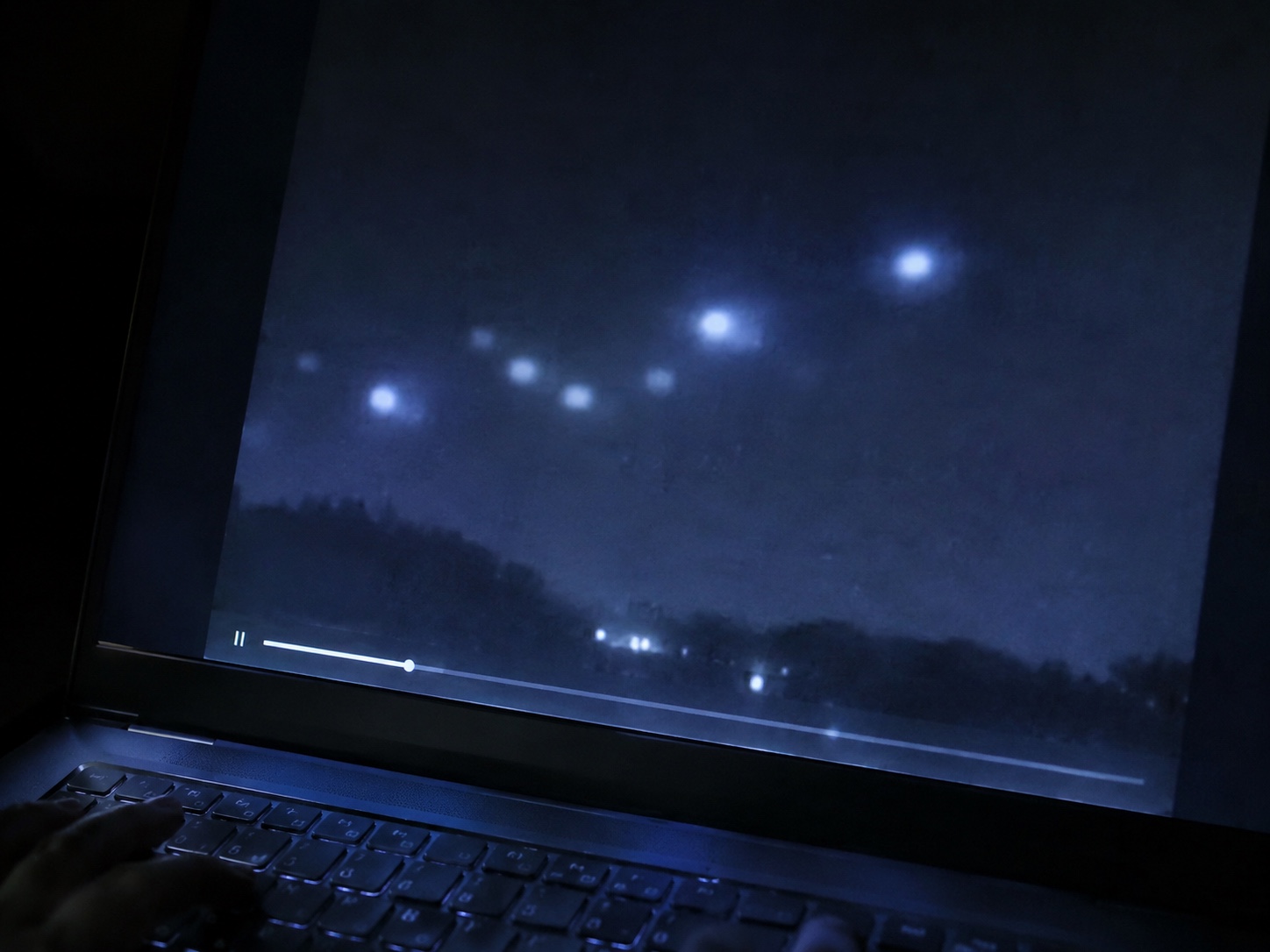
Many of the images circulated as “UFO photos” are misreadings of how things look in photos, or old images that have been reposted, composited or generated by AI. This certification, UFO Kanteishi (certified UFO analyst), puts weight on information literacy: calmly judging whether information is true by observing, recording and cross-checking. This page sets out the basic terms and ideas behind it.
Three steps to try first
- 1. Use a reverse image search to check whether the same image has circulated before.
- 2. Check whether Exif (shooting information) is present and look at the date, for clues of editing or reposting.
- 3. Compare it with known appearances (lens flare, focus blur, compression noise, etc.).
Information literacy terms
Cognitive bias
A skew in thinking in which experience, emotions or preconceptions distort judgment without our noticing. Human judgment is not always objective, so to improve the quality of observation, recording and analysis, it is important to be aware of the images and preconceptions you hold. Bias works not only in the direction of believing too much but also in the direction of dismissing too much.
Confirmation bias
The tendency to favor information that supports what you already believe and to ignore or play down information that contradicts it. If you watch a video already convinced that “this is a UFO,” you tend to notice only the points that are hard to explain, rather than what it has in common with known phenomena. An effective countermeasure is not to rush to a conclusion and to work through known phenomena one by one.
Pareidolia
The perceptual phenomenon of seeing faces or meaningful shapes in random patterns or vague forms. If a point of light whose outline has broken up from compression noise or focus blur seems to you to “have a disc-shaped structure” or “show window-like patterns,” pareidolia may be at work. Images processed with AI enhancement or upscaling make this even more likely.
Testimony contamination
The phenomenon in which, after a sighting, exposure to news, social media or other people's accounts mixes content that differs from the first impression into the memory. The basic stance when reading testimony is to recognize that memory is not a recording but something that keeps being updated. Accounts recorded right after a sighting tend to be more reliable than those recorded later.
Collective misidentification
The phenomenon in which several people come to share the same mistaken interpretation. When one person says “that's a UFO,” the interpretation can spread to the people around them, and several witnesses may end up giving accounts based on the same interpretation. If witnesses shared information with each other beforehand, their accounts cannot be called independent.
Expectation effect
The phenomenon in which, if you look up at the sky expecting that “I might see something,” you are more likely to pay attention to lights and movements you would normally ignore. One reason for the many sighting reports at places known as UFO-watching spots may be that observers' attention is directed that way.
The hierarchy of information (primary, secondary, tertiary)
A way of classifying information by its distance from the source. Primary information is closest to the event, such as the photographer's own original file or original documents from a public body. Secondary information is articles or reposts that edit or comment on it, and tertiary information and beyond are stages where it has changed even further. In the way UFO information circulates, third- or fourth-hand information is often treated as primary information, so the habit of checking which stages a piece of information has passed through is the starting point for evaluating it.
The gap between headline and evidence
The principle that the strength of a headline and the strength of its evidence are two different things. Words like “conclusive proof,” “completely unexplainable” and “the government finally releases” attract attention, but the body of the article often says no more than “it is possible” or “one expert said.” It is important to check the body text, the source being cited, and even the credentials of the expert.
Expressions that lower credibility
Absolute claims such as “completely unexplainable,” “scientists admit it” and “100% real,” and lines of argument that shut down critical examination, such as “the mainstream media won't report it” or “the experts are hiding it.” Scientific investigations usually use hedged expressions such as “it is possible” or “based on current data.” Whether something is widely reported has nothing to do with its value, and you cannot judge whether it is true from the way it is expressed alone.
“No evidence” is not “does not exist”
The statement “no evidence of extraterrestrial origin has been confirmed” does not deny that anything of extraterrestrial origin exists; it means that nothing could be confirmed within the scope of the investigation so far. “There is no evidence” and “it does not exist” mean different things, and scientific reports need to be read for their methods, the range of their data and their limitations, not just their conclusions.
Reverse image search
A technique that uses tools such as Google or TinEye to check whether the same image or video has been used before in a different context. It is an effective basic way to find reused footage, and many fakes turn out at this stage to match something that already exists.
Typical patterns in fake videos
Features that tend to appear in footage composited with CG or image editing. They include mismatched light and shadow, a mismatch between the movement of the object and the movement of the camera, mismatched resolution within the footage, and reuse of existing footage. Judging light and shadow takes specialist knowledge, so be aware that amateur judgments are prone to error.
Exif data (metadata)
Shooting information attached to still images, which may include the date and time, the camera used and GPS information. Because metadata can be deleted or altered, it cannot by itself establish whether an image is genuine. It is one supporting item for checking videos and images.
Separating observed facts from impressions
The practice of separating what can be recorded as fact from what should be recorded as an impression. Instead of subjective expressions such as “it was huge” or “it was unbelievably fast,” make them concrete, such as “its apparent size was about X times the full moon” or “it took X seconds to pass.” “It suddenly disappeared” is an observed fact, but “it teleported” is an interpretation and is left out at the analysis stage.
Basic items to record
What was seen, when, where, in which direction and for how long: the core information of an observation record and the basis for cross-checking. Information without these items cannot be cross-checked at all. Impressions and interpretations are left out at this stage; first write down only what can be recorded as observed fact.
Elevation angle
The angle that shows how high an object appears, with the horizon at 0 degrees and the zenith at 90 degrees. It is an important item in an observation record and is used for cross-checking against astronomical information. The width of your fist with your arm stretched out level is a rough guide to about 10 degrees.
Apparent size
A practical way of recording size by comparing it with the moon or stars, since size is hard to estimate when the distance is unknown. A record such as “its apparent size was about five times the full moon” gives useful information for cross-checking later.
Cross-check flow
The procedure for comparing organized observation data with known information. After confirming the basic information, cross-check in this order: space-related → astronomical information → aviation information → weather information → optical artifacts in videos and photos. Useful tools include ISS and Starlink pass predictions, astronomy simulation software, flight trackers, and AMeDAS data from the Japan Meteorological Agency (JMA), Japan's network of automated weather stations.
The six blocks of the official observation report
The structure of the Board's official report. It consists of six blocks: Report Administration, Observation Summary, Characteristics of the Object, Recorded Data, UFO Classification, and the Analysis Section. The date, time, place and direction of the observation are the most important items, since they bear directly on later cross-checking, so fill them in as accurately as possible. The Analysis Section is completed by a certified UFO Kanteishi, not by the reporter.
Marking uncertain information
A way of recording that avoids writing uncertain information as if it were certain. State the range or uncertainty: the time as “around X o'clock,” the size as “about X times the full moon (estimated; distance unknown),” the color as “bluish white or white (could not be determined because of poor conditions).” Leaving out parts you cannot remember clearly and entering only the facts you could confirm is also a sound decision.
Cross-checking from multiple angles
The importance of verifying from several angles, beyond the characteristics of the equipment, the shooting conditions and a single field of expertise. In the Chilean Navy video (2014), infrared footage that an expert body had called “unexplained” was later analyzed as the contrail from a jet's engines. Even an expert body's judgment can sometimes be explained as a known phenomenon by later analysis.
How to identify misidentifications caused by photography (lens flare, spheres, satellites and so on) is covered in How to identify UFOs, and the full list of terms is in the UFO/UAP glossary.
FAQ
How can I check whether a photo shows a UFO?+
First, use a reverse image search to check whether the same image has circulated before, then see whether it has Exif data (records such as the date and time and the camera model). Next, compare it with the typical appearances caused by photography, such as lens flare, focus blur and compression noise.
What is a reverse image search?+
A way of searching from the image itself to see whether the same or a similar image already exists on the internet. It can reveal that a “UFO image” going around was actually a different, older photo, a composite, or AI-generated.
What can Exif data tell me?+
Exif is shooting information recorded in the photo file (the date and time, the camera model, settings and so on). Exif that is unnaturally missing, or a date that does not match, can be a clue to editing or reposting.
UFO Kanteishi Exam, Grade 3
Grade 3 of the UFO Kanteishi Exam is free and needs no account. Test your observing, recording and cross-checking skills in 20 questions.
To become a Licensed UFO Kanteishi, take Grade 2 (Official Guide + exam).