
GLOSSARY
UFO/UAP Glossary
Fact-based, plain-language definitions of the terms used around UFOs and UAP: the basics for treating the unidentified correctly, as unidentified. 83 terms, based on the UFO Kanteishi Grade 3 and Grade 2 Official Guides.
Basic Concepts and Definitions
UFO (unidentified flying object)
Short for “unidentified flying object.” In everyday speech the word is often used to mean an alien spacecraft, but the term UFO itself says nothing about extraterrestrial origin. It is a neutral word for something seen in the sky whose identity cannot be confirmed right away.
Read more →UAP (unidentified anomalous phenomena)
Short for “unidentified anomalous phenomena.” Where “UFO” suggests a flying object, UAP is a broader concept that also covers phenomena that do not fly and phenomena observed underwater. Since the 2020s, government agencies and research bodies have mostly used the term UAP rather than UFO.
Read more →The meaning of “unidentified”
When something is seen in the sky, “unidentified” describes the state in which its identity has not been determined so far. It does not mean “unknown technology,” “beyond scientific explanation” or “involving extraterrestrial life.” It refers to the state itself, in which every possibility, such as an aircraft, a satellite, a planet or lens flare, is still open.
Read more →“Unidentified” vs. “extraterrestrial origin”
The distinction this certification treats as the most important. “Unidentified” only means that the identity is not known; it does not mean “of extraterrestrial origin.” Being unidentified is not evidence of extraterrestrial technology or the paranormal, and the two must be treated as entirely separate concepts.
Read more →From UFO to UAP: how the definitions changed
The term UFO spread after 1947 and was at first a neutral concept that the military and government used to sort out phenomena in the sky. From around 2020, the name UAP (then “unidentified aerial phenomena”) came into use in official documents, led by the U.S. Navy (the UAP Task Force was set up that year, and the term took hold with the 2021 preliminary assessment by the Office of the Director of National Intelligence). In 2022 the definition was broadened to “unidentified anomalous phenomena.” With that, the scope widened from “objects flying in the sky” to “anomalous phenomena observed in any domain,” including underwater and in space.
Read more →The Board's position
The UFO Kanteishi Certification Board does not treat UFOs and UAP as alien spacecraft. It treats them as phenomena in the sky whose identity cannot be confirmed right away. Rather than declaring what the unknown is, the Board emphasizes careful checking of observing conditions, records, cross-checking against known phenomena and the reliability of sources, so that the unidentified is treated correctly: as unidentified.
Read more →Treat the unidentified correctly: as unidentified
The fundamental attitude the Board values most, consistently from Grade 3 upward. It asks neither for every phenomenon to be dismissed as something known nor for special meaning to be found in every unidentified one. It values an honest process: carefully cross-check what can be identified, and record what cannot be identified as unidentified, so that it can feed into the next analysis.
Read more →Status of this certification
UFO Kanteishi (certified UFO analyst) is a private (non-governmental) certification for learning, step by step, the history, observation, recording, classification and analysis of unidentified phenomena in the sky, and the information literacy around them. It does not guarantee that extraterrestrial life, the paranormal, special abilities or the ability to communicate with anything exist, or that anyone will acquire them. It is not a national or public qualification, and it does not guarantee employment, income, work contracts or professional analysis skills.
Read more →A–F classification
The Board's own classification system, designed for study and practical use. It is not an official classification of NASA, AARO or any other agency. The idea is not to “guess what it was” but to “sort out what can be said at this point, according to the amount of information.” A: Identified as a specific known phenomenon. B: Artificial object. C: Natural, meteorological or astronomical phenomenon. D: Photographic or optical effect. E: Undeterminable due to insufficient information. F: Does not fit known categories, even when sufficient information is available.
Read more →Class E (undeterminable due to insufficient information)
The class used when basic information such as the date and time, location, direction, duration and shooting conditions cannot be confirmed, so the case cannot be cross-checked against known phenomena. It is treated as the most important class in Grade 3: when information is lacking, being able to say “we don't know” accurately is an important skill for avoiding mistaken conclusions. Also called “suspended judgment.”
Read more →Class F (does not fit known categories)
A class used with care, only when the date and time, location, direction, shooting conditions and so on are reasonably complete and the case is still hard to explain after thorough cross-checking against known phenomena. It means something entirely different from class E (insufficient information), and classifying a case as F while information is still lacking is an error. F does not mean extraterrestrial origin.
Read more →Classification flow
The order of steps for classifying a case. Step 1: check the information (E if it is unclear). Step 2: cross-check against known phenomena (A if identified). Step 3: judge which category the candidates fall into (B for artificial objects, C for natural, meteorological or astronomical phenomena, D for photographic or optical effects). Step 4: F, only if the case is hard to explain. It is important not to skip steps.
Read more →Investigative Bodies and Organizations
Project Blue Book
A UFO investigation program run by the U.S. Air Force from 1952 to 1969, based at Wright-Patterson Air Force Base in Ohio. In total it recorded 12,618 cases, of which 11,917 were explained as known phenomena; 701 remained “unidentified.” The Air Force concluded that it had found no evidence, including in the unidentified cases, of a threat to national security or of extraterrestrial vehicles. The program ended in December 1969, following the Condon Committee report released in January of that year.
Read more →Projects SIGN and GRUDGE (early investigations)
Early investigation projects that the U.S. Air Force set up to deal with the surge in UFO sighting reports after 1947: Project SIGN in 1948 and Project GRUDGE in 1949. Like Project Blue Book, they were carried out so that the military could sort out phenomena in the sky, and through them the term “unidentified flying object (UFO)” became established in official military documents.
Read more →Condon Committee
A committee at the University of Colorado that evaluated UFO research in 1966–1968 with funding from the U.S. Air Force. Its report, completed in 1968 and released in January 1969, concluded that continuing UFO research was unlikely to yield scientific results, and Project Blue Book ended in December 1969 as a result.
Read more →AATIP (Advanced Aerospace Threat Identification Program)
Short for the Advanced Aerospace Threat Identification Program, a UFO investigation program that the U.S. Department of Defense once ran in secret. The New York Times reported its existence in December 2017, and videos taken by Navy aircraft were also made public. The Department of Defense acknowledged that the program had existed, and in April 2020 it officially released three of the videos as unclassified material. This was a major turning point: the name UAP began to appear in official documents, and interest in government disclosure grew.
Read more →AARO (All-domain Anomaly Resolution Office)
Short for the All-domain Anomaly Resolution Office, set up by the U.S. Department of Defense in July 2022. It handles unidentified phenomena in every domain in one place, from space, the air and underwater to objects that move between them, and collects and analyzes UAP reports from the military and intelligence agencies. Its 2024 historical record report concluded that none of the claims that the government had confirmed evidence of extraterrestrial technology were substantiated. It also runs reporting channels, standardizes classification criteria and reports regularly to Congress.
Read more →NASA UAP Independent Study Team
An independent study team that NASA announced on June 9, 2022, to examine UAP scientifically; its members were named and the study began in October 2022. Its 16 members were specialists from a range of fields, including space science, Earth science, aeronautical engineering, artificial intelligence and data analysis. After about a year of work, it published its final report in September 2023. The report states that there is no evidence of extraterrestrial origin, and points out that the available data are fragmentary and insufficient in both quality and quantity, and that standardized sensors and high-quality data are needed.
Read more →GEIPAN (France's official UAP study group)
An official study group established in France in 1977 under the French space agency CNES (founded as GEPAN, renamed SEPRA in 1988 and GEIPAN in 2005). It systematically collects, analyzes and publishes sighting reports, and is highly regarded internationally as a body with an ongoing official investigation system. It has processed several thousand reports so far, and a certain number of them are recorded as hard to explain by known phenomena.
Read more →Japan's Ministry of Defense UAP procedures
In Japan, since 2020, the Ministry of Defense has set out procedures for what Self-Defense Forces (SDF) personnel should do if they see UAP, with a policy requiring them to record images and data and to report. No official investigative body has been set up, but an institutional response has begun.
Read more →MUFON (Mutual UFO Network)
A private American UFO investigation organization, founded in 1969 as the Midwest UFO Network and renamed the Mutual UFO Network in 1973. It collects sighting reports from around the world and keeps them in a database. The quality of the reports varies, but the volume of accumulated data is very large, and researchers use it as one of their sources.
Read more →SCU (Scientific Coalition for UAP Studies)
Short for the Scientific Coalition for UAP Studies, a private research organization made up of specialists such as scientists, engineers and former military personnel. It carries out scientific analyses of specific cases and publishes them as papers.
Read more →CEFAA (Chile's UAP investigation agency)
The Chilean government's UAP investigation agency. After about two years of investigation, it released infrared footage taken by a Chilean Navy helicopter in 2014 as “unexplained.” Several researchers later submitted analyses showing that the object in the footage was a jet aircraft's condensation trail (contrail). CEFAA expressed doubts, but many experts support the jet aircraft explanation.
Read more →Sighting History and Major Cases
Kenneth Arnold Sighting (1947)
On June 24, 1947, Kenneth Arnold, an American businessman and pilot, reported seeing nine mysterious flying objects while flying near Mount Rainier in Washington State. He described their motion as being like a saucer skipping across water, which the media reported as “flying saucers,” setting off the UFO boom that followed. The sighting report itself is considered highly credible, but what the objects were has not been identified to this day.
Read more →Flying saucer
A name used in news reports after Kenneth Arnold described the motion of the objects he saw as being like a saucer skipping across water. The phrase set off a sudden rise in public interest in UFOs. Arnold's description was of the objects' motion, not a direct description of their shape.
Read more →Roswell Incident (1947)
In July 1947, a series of reports said that a mysterious flying object had crashed on a ranch near Roswell, New Mexico. The U.S. Army Air Forces first announced that it had recovered a “flying disc,” but corrected this the same day, saying it was the wreckage of a weather balloon. The contradiction created deep suspicion, and the incident became a symbol of UFO conspiracy theories. A 1994 Air Force report explained the object as a balloon from Project Mogul, a secret balloon program, and a 1997 report concluded that the supposed “alien bodies” were most likely anthropomorphic dummies used in drop tests from high-altitude balloons.
Read more →Tehran Incident (1976)
In September 1976, over Tehran, the capital of Iran, an Iranian Air Force F-4 fighter tried to approach a UFO. It was reported that the instruments malfunctioned and that the systems shut down when the crew tried to fire a missile. There are multiple accounts from military pilots and ground controllers, official documents were later released, and the reports include an unusual effect on electronics, so it is often treated as a highly credible case.
Read more →Rendlesham Forest Incident (1980)
In December 1980, several U.S. Air Force personnel reported seeing mysterious lights and a flying object in Rendlesham Forest, next to RAF Woodbridge (a Royal Air Force base used by the U.S. Air Force) in Suffolk, England. The next morning, depressions were found in the ground at the site, and there are also records saying that radiation readings were higher than in the surrounding area. It has been suggested that the lights may have been the rotating beam of the Orford Ness lighthouse. The case is cited as one that mixes parts known phenomena can explain with parts that are hard to explain.
Read more →Belgian UFO Wave (1989–1990)
A series of sightings of large triangular flying objects in Belgium between November 1989 and April 1990. The witnesses ranged from members of the public to police officers and military personnel, and the number of reports is said to have reached several thousand. The Belgian Air Force reported scrambling F-16s and tracking an object on radar, but some of the photos were later found to be fakes. There are several hypotheses about what was seen, including experimental stealth aircraft, weather phenomena and collective illusion, and there is no official conclusion.
Read more →Related: UFO Type Quiz, “Black Triangle”Phoenix Lights (1997)
On the night of March 13, 1997, many people in Arizona saw lights in the sky. Two events are involved: a V-shaped set of lights that moved across the state at around 8 p.m., and lights that appeared to hang in a row in the sky near Phoenix at around 10 p.m. The Air National Guard explained the latter as flares dropped by A-10 attack aircraft during training. Some think the former was a formation of aircraft, but interpretations of the eyewitness accounts are still disputed. Several video recordings also exist.
Read more →Chilean Navy Video (2014)
In November 2014, a Chilean Navy helicopter flying along the coast filmed a mysterious flying object with an infrared camera for about nine minutes. After about two years of investigation, CEFAA released the footage as “unexplained.” Several analyses later concluded that the object was a jet aircraft and that the infrared camera had picked up the condensation trail from its engines. The case carries a lesson: even footage that an expert body has called unexplained can sometimes be explained later as a known phenomenon.
Read more →JAL Flight 1628 Incident (1986)
On November 17, 1986, the crew of a Japan Airlines jumbo jet (JAL Flight 1628) reported seeing a mysterious flying object for about 50 minutes while flying over Alaska. Captain Kenju Terauchi testified that a huge object flew alongside his aircraft, and he kept to his account consistently afterward. The FAA (Federal Aviation Administration) investigated and its records remain. The case drew international attention as a long sighting by a veteran pilot, but there is no official conclusion.
Read more →Celestial phenomenon over Nuremberg (1561)
An event in 1561 in Nuremberg (in present-day Germany) in which many spheres and cylindrical objects are said to have appeared in the sky and moved as if fighting one another. It is recorded together with a woodcut from the time. A similar phenomenon was recorded in Basel (in present-day Switzerland) in 1566. Modern researchers have suggested atmospheric optical phenomena, or weather phenomena such as sun dogs and light pillars, as possible explanations.
Read more →Official release of the DoD UAP videos (FLIR1, Gimbal, GoFast)
Three UAP videos that drew attention following the New York Times' 2017 report on the existence of AATIP. In April 2020, the U.S. Department of Defense officially released the three videos, FLIR1, Gimbal and GoFast. It was one of the moments that led to government UAP disclosure becoming institutionalized.
Read more →UAP preliminary assessment (2021)
A report on UAP that the U.S. Office of the Director of National Intelligence (ODNI) submitted to Congress and made public in June 2021. Of 144 UAP reports, 143 were left unexplained. It is one of the events that show the recent progress of the U.S. government's official recognition of UAP and its disclosure of information.
Read more →David Grusch testimony (2023)
In July 2023, David Grusch, a former U.S. military intelligence officer, testified at a congressional hearing that the government had recovered craft of "non-human" origin and was keeping them in secret, which drew wide attention. However, AARO has reported that its investigation found no evidence to support these claims. The mismatch between the congressional testimony and the findings of government agencies is still an ongoing issue.
Read more →Shapes and Appearance
Triangular flying objects
During the Belgian UFO Wave of 1989–1990, there was a series of reports of large triangular flying objects, said to number several thousand. Several hypotheses have been proposed about what they were, including experimental stealth aircraft, weather phenomena and collective illusion, but there is no official conclusion. Some of the photos reported have been found to be fakes.
Read more →Related: UFO Type Quiz, “Black Triangle”Triangular and bat-wing silhouettes of stealth aircraft
Stealth aircraft such as the B-2 Spirit bomber and the F-117 Nighthawk have special shapes that minimize radar reflections, giving them distinctive triangular or bat-wing silhouettes. When seen at night, they are sometimes reported as “mysterious triangular flying objects.” During the Cold War there were also cases in which secret military aircraft were later confirmed to be the cause of UFO reports.
Read more →Related: UFO Type Quiz, “Black Triangle”Spheres and balls of light
In Nuremberg in 1561, an event in which many spheres and cylindrical objects appeared in the sky and moved as if fighting one another was recorded along with a woodcut. Across medieval Europe, there are records of flaming swords and balls of light appearing in the sky. Modern researchers have suggested atmospheric optical phenomena, or weather phenomena such as sun dogs and light pillars, as possible explanations.
Read more →Related: UFO Type Quiz, “Orb”Glowing spheres (ball lightning)
Ball lightning is a glowing sphere that appears during thunderstorms and at other times: a ball of light from a few centimeters to several meters across drifts through the air and vanishes after a few seconds to a few minutes. Its existence is supported by many eyewitness accounts, but how it forms is still not fully understood. Because it moves irregularly and disappears suddenly, it is sometimes reported as a UFO.
Read more →Related: UFO Type Quiz, “Orb”Disk shapes (from optical misidentification)
When the subject is out of focus, a light source that is really a point is recorded as a large, spread-out blur, which, depending on the shape of the lens, can be round, hexagonal, octagonal and so on, and is sometimes mistaken for a “disk-shaped object.” Lenticular clouds that form downwind of mountains (elliptical, disk-shaped or plate-like) are also easily mistaken for disk-shaped objects hovering in the sky.
Read more →Elongated oval (a shape category in reports)
In the shape field of the Board's official report, the apparent shape is entered as, for example, “round,” “triangular,” “elongated oval” or “point of light (shape unknown).” If the shape could not be made out, enter “only a point of light seen; shape unknown,” and avoid guessing at a shape you did not confirm. Apparent size is recorded by comparison, as in “about X times the size of the full moon.”
Read more →Known Phenomena Often Mistaken for UFOs
Aircraft (position lights and strobe lights)
Aircraft are the most common thing mistaken for a UFO in reports. At night, position lights are lit: red on the left wingtip, green on the right wingtip and white on the tail. Red anti-collision lights (beacons) flash on the top and bottom of the fuselage, and white strobe lights flash on the wingtips and elsewhere. How the colors and flashing look varies greatly with distance, angle, weather and shooting conditions, and to someone not used to them they can seem like unidentified lights.
Read more →Aircraft approaching head-on
An aircraft approaching an observer almost head-on barely changes its direction as seen by the observer, so it can appear to hang in roughly the same spot for a long time. When the angle then changes, it seems to start moving sideways suddenly, and it may be mistaken for something that “suddenly moved at high speed.” This is not a change in the object's motion but a change in the viewing angle.
Read more →Military and stealth aircraft
Military aircraft on training flights and exercises sometimes fly routes that do not show up on civilian flight trackers. Stealth aircraft such as the B-2 Spirit and the F-117 have distinctive triangular or bat-wing silhouettes, and when seen at night they are sometimes reported as “mysterious triangular flying objects.” For the triangular objects of the Belgian UFO Wave, too, experimental stealth aircraft have been proposed as one hypothesis.
Read more →Related: UFO Type Quiz, “Black Triangle”Drones (uncrewed flying objects)
As civilian drones have spread, reports that mistake lights at night for something unknown have increased. Multicopters can take off and land vertically, hover, fly slowly and change direction quickly, and these moves, impossible for conventional aircraft, can look “UFO-like.” At night the airframe is hard to see, and only the LED lights may be visible, as several points of light moving irregularly.
Read more →Satellites
Satellites are visible because they reflect sunlight, so they are easiest to see in the limited window after sunset and before dawn; in the middle of the night they pass into Earth's shadow and can no longer be seen. They appear as points of light that do not blink and move in a straight line at a constant speed, taking a few minutes to cross from horizon to horizon. If an observation record includes the date and time, location and direction, a pass can be cross-checked afterward with a dedicated prediction service.
Read more →ISS (International Space Station)
The ISS is a large structure that circles Earth about every 90 minutes at an altitude of about 400 km (about 250 miles). In good conditions it is brighter than any star and clearly visible to the naked eye. Because it crosses the sky as a bright point of light for several minutes, people not used to it may see it as a mysterious glowing object. Pass predictions can be checked in advance on NASA's website or in dedicated apps and cross-checked against observation records.
Read more →Starlink satellites (satellite trains)
For a few days after launch, SpaceX's Starlink satellites can be seen as a “satellite train”: several satellites moving in a line at regular intervals. Because of this unusual appearance, a row of evenly spaced points of light moving in a straight line, they have been reported around the world as “a mysterious line of lights.” Once they reach their orbits they spread out as individual satellites, so the train shape is visible only for a limited time right after launch.
Read more →Reentry debris
When a satellite that has finished its mission or parts of a rocket reenter the atmosphere, several fragments burn up as they cross the sky over tens of seconds to several minutes. They look similar to a fireball, but are characterized by several points of light that slowly spread apart as they move, and they are sometimes reported as UFOs flying in formation. Reentry predictions can sometimes be checked in advance in official information from JAXA (the Japan Aerospace Exploration Agency) or the U.S. Space Force.
Read more →Bright planets (Venus and Jupiter)
Venus and Jupiter are very bright and stand out in the western sky in the evening and the eastern sky before dawn. Low in the sky, the atmosphere can make them seem to shimmer or change color, and when they slip in and out of gaps in the clouds, they can seem to “appear and disappear repeatedly.” For a bright light that stays in roughly the same place for a long time, consider planets and stars first.
Read more →Weather balloons (radiosondes)
The Japan Meteorological Agency (JMA) regularly launches weather balloons from sites across Japan, about twice a day; they send back data as they rise to around 30 km (about 19 miles). After sunset or before dawn they can catch sunlight high up and look from the ground like bright points of light that have suddenly appeared. Because they drift at high altitude for a long time, they are sometimes reported as unfamiliar objects.
Read more →Lenticular clouds (cap clouds)
Lenticular clouds (including cap clouds) form on the downwind side of mountains and in similar places, and take elliptical, disk-shaped or stacked-plate forms. They can keep their shape in the same place even in strong winds. The cloud as a whole is not moving; its shape is maintained because water vapor is constantly supplied and then dissipates again. Tinged red or orange at sunset or dawn, they are easily mistaken for disk-shaped objects hovering in the sky.
Read more →Noctilucent clouds
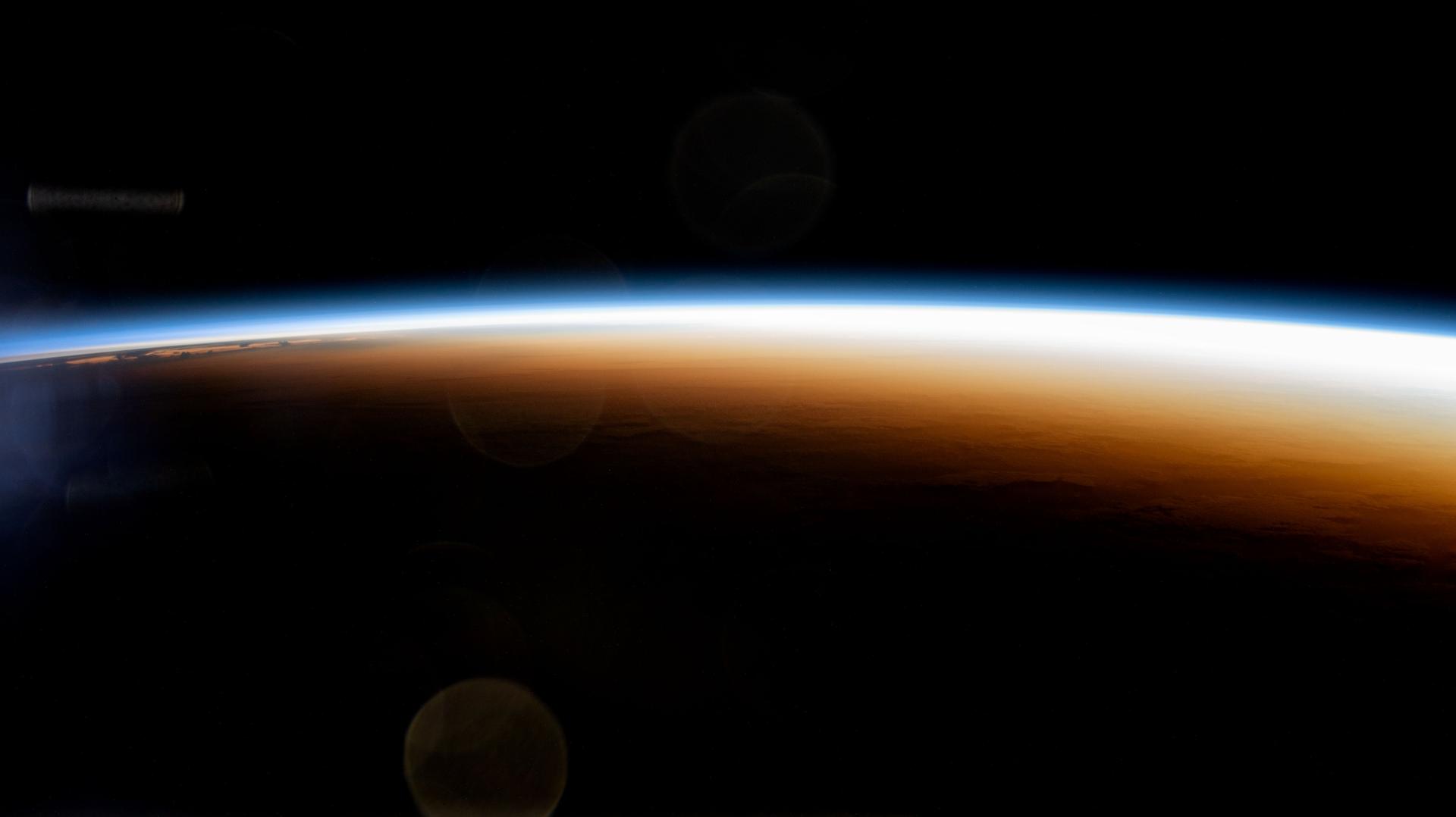
Noctilucent clouds form in the mesosphere at an altitude of around 80 km (about 50 miles; sources give roughly 75–90 km) and can be seen after sunset or before sunrise in summer at high latitudes (50° N or higher). After the ground has gone dark, these high clouds are still lit by the sun and appear to glow bluish white. In Japan they are rarely observed, in places such as Hokkaido.
Read more →Light pillars
An atmospheric optical phenomenon in which ice crystals falling through the air reflect light, so that the light appears to stretch up and down like a column. At night, artificial light such as streetlights can reflect off ice crystals and look like several columns of light standing in the sky.
Read more →Sun dogs (parhelia)
An atmospheric optical phenomenon in which bright lights appear on either side of the sun. Depending on conditions, it can look as if there are several light sources in the sky. Modern researchers have suggested that the phenomena in the sky recorded in Nuremberg in 1561 and in Basel in 1566 may also have been sun dogs, light pillars or similar.
Read more →Meteors and fireballs
A meteor is space dust or a small body burning up after entering Earth's atmosphere, moving at tens of kilometers per second. Especially bright fireballs, magnitude −4 or brighter, stay visible for several seconds to over ten seconds. They can break apart while burning, so that several points of light seem to move side by side, and a glowing trail (meteor train) can remain as a band of light for several minutes. Sometimes a sound arrives after a delay.
Read more →Lens flare
Rings, streaks, hexagonal or octagonal spots of light, haze and similar effects that appear in photos and videos when strong light enters the lens. Lens ghosts often appear on the opposite side of the frame's center from the light source, and move in the opposite direction to it when the camera moves. If a point of light shows up only in a photo and was not seen with the naked eye, consider this possibility first.
Read more →Lens ghost
An optical image produced by reflections inside the lens; several shapes resembling the actual light source can appear. It is often recorded as a round ring of light or part of an arc. Like lens flare, it needs attention as a cause of misidentification in photos and videos.
Read more →Focus errors and camera shake
When a shot is out of focus, a light source that is really a point is recorded, depending on the shape of the lens, as a round, hexagonal, octagonal or similar blur (bokeh), and may be mistaken for a “disk-shaped object.” Camera shake stretches points of light into lines or arcs, producing images in which a light seems to have “suddenly accelerated” or “suddenly changed direction.” Long exposures taken without a tripod can also record stars or aircraft as trails that seem to have moved a long way.
Read more →Image processing, compression noise and AI enhancement
Videos posted on social media and video platforms lose detail through file compression, which can create blocky noise and shapes or patterns that were not really there. Smartphone AI enhancement, low-light mode processing and upscaling or sharpening software can also emphasize outlines, structures and colors that did not exist. Use the original data for analysis, and avoid drawing conclusions from processed data alone.
Read more →Autokinetic effect
A visual phenomenon in which a stationary point of light seen in darkness seems to move. Stars and planets that are not actually moving can seem to “wobble” or “drift.” It is a cause of misidentification that comes from human vision itself, not from a camera.
Read more →Information Literacy and Observation Records
Cognitive bias
A skew in thinking by which experience, emotion and preconceptions distort judgment without our noticing. Human judgment is not always objective, so to improve the quality of observation, recording and analysis, it is important to be aware of the images and preconceptions you hold. Bias works not only toward believing too readily but also toward dismissing too readily.
Read more →Confirmation bias
The tendency to favor information that supports what you already believe and to ignore or downplay information that contradicts it. If you watch a video already convinced that “this is a UFO,” you tend to notice only the points that are hard to explain rather than what it has in common with known phenomena. An effective countermeasure is not to rush to a conclusion and to consider known phenomena first, one by one.
Read more →Pareidolia
The perceptual tendency to see faces or meaningful shapes in random patterns or vague forms. If a point of light whose outline has broken down through compression noise or poor focus seems to “have a disk-shaped structure” or “show a pattern like windows,” pareidolia may be at work. Images that have gone through AI enhancement or upscaling make this even more likely.
Read more →Testimony contamination
When details that differ from the first impression get mixed into a witness's memory after the sighting, through the news, social media or other people's accounts. The basic attitude when reading testimony is to recognize that memory is not a recording but something that keeps being updated. Testimony recorded right after a sighting tends to be more reliable than testimony recorded later.
Read more →Collective misidentification
When several people come to share the same mistaken interpretation. Once one person says “that's a UFO,” the interpretation can spread to those around them, and several witnesses may end up giving testimony with the same interpretation. If witnesses shared information beforehand, their accounts cannot be called independent.
Read more →Expectation effect
When you look up at the sky expecting that you might see something, you are more likely to focus on lights and movements you would normally ignore. One reason there are many sighting reports from places known as UFO-watching spots may be that observers' attention is already directed that way.
Read more →Levels of information (primary, secondary, tertiary)
A way of classifying information by its distance from the source. Primary information is closest to the event, such as the photographer's own original file or an agency's original documents; secondary information is articles or reposts that edit or explain it; and tertiary information and beyond have been changed even further. In the circulation of UFO information, tertiary and quaternary information is often treated as if it were primary, so the habit of checking what stages a piece of information has passed through is the starting point for evaluating it.
Read more →Gap between headline and evidence
The principle that the strength of a headline and the strength of its evidence are two different things. Words like “conclusive proof,” “completely unexplainable” and “the government finally releases” attract attention, but the article itself often only says “it is possible” or “one expert said.” It is important to check the body of the article, the original source and the expert's credentials.
Read more →Wording that lowers credibility
Absolute claims such as “completely unexplainable,” “even scientists admit it” and “100% real,” and lines of argument that shut down critical examination, such as “the mainstream media won't report it” and “experts are hiding it.” Scientific investigations usually use hedged wording such as “it is possible” or “based on current data.” Whether information is widely reported has nothing to do with its value, and truth cannot be judged from the wording alone.
Read more →“No evidence” vs. “does not exist”
A statement such as “no evidence of extraterrestrial origin has been confirmed” does not deny that extraterrestrial origin exists; it means that none could be confirmed within the scope of the investigation so far. “There is no evidence” and “it does not exist” mean different things, and scientific reports need to be read not only for their conclusions but also for what they say about methods, the scope of the data and limitations.
Read more →Reverse image search
A method of using tools such as Google or TinEye to check whether the same image or video has been used before in a different context. It is an effective basic way to catch reused footage, and many fakes turn out at this stage to match existing material.
Read more →Typical patterns in fake videos
Features that tend to appear in videos composited with CGI or image editing: light and shadow that don't match, an object's movement that doesn't match the camera's movement, mismatched resolution within the footage, reused existing footage and so on. Note that judging light and shadow takes specialist knowledge, and amateur judgments are prone to error.
Read more →Exif data (metadata)
Shooting information attached to still images, which may give the date and time, the camera used, GPS location and more. However, metadata can be deleted or altered, so it cannot be used on its own to judge whether an image is genuine. It is one supporting item for checking videos and images.
Read more →Observed facts vs. impressions
The practice of separating what can be recorded as fact from what should be recorded as an impression. Instead of subjective expressions such as “it was huge” or “it was unbelievably fast,” make it concrete: “its apparent size was about X times that of the full moon,” “it took X seconds to pass.” “It suddenly disappeared” is an observed fact, but “it teleported” is an interpretation and is not included at the analysis stage.
Read more →Basic items to record
The core information of an observation record, which cross-checking depends on: what was seen, when, where, in which direction and for how long. Information without these items cannot be cross-checked at all. Leave out impressions and interpretations at this stage, and first write down only what can be recorded as observed fact.
Read more →Elevation angle
The angle that shows how high an object appears, with the horizon at 0 degrees and the zenith at 90 degrees. It is an important item in an observation record and is used for cross-checking against astronomical data. As a guide, the width of your fist with your arm held straight out is about 10 degrees.
Read more →Apparent size
Because size is hard to estimate when the distance is unknown, a practical way to record it is by comparison with the moon or stars. A record such as “its apparent size was about five times that of the full moon” becomes useful information for later cross-checking.
Read more →Cross-check flow
The procedure for cross-checking organized observation data against known information. After confirming the basic information, cross-check in this order: space objects, astronomical data, aviation data, weather data and finally optical artifacts in videos and photos. Tools include ISS and Starlink pass predictions, astronomy simulation software, flight trackers and AMeDAS data from the Japan Meteorological Agency (JMA's network of automated weather stations).
Read more →The six blocks of the official observation report
The structure of the Board's official report. It consists of six blocks: Report Administration, Observation Overview, Object Characteristics, Recorded Data, UFO Classification and the Analyst's Section. The observation date and time, location and direction are the most important items, since later cross-checking depends directly on them, and should be filled in as accurately as possible. The Analyst's Section is completed by a UFO Kanteishi certified by the Board, not by the person making the report.
Read more →Marking uncertain information
A way of recording that avoids writing uncertain information as if it were certain. State the range or the uncertainty: for the time, “around X o'clock”; for size, “roughly X times the size of the full moon (estimate; distance unknown)”; for color, “bluish white or white (could not be determined; poor conditions).” Leaving out parts you do not remember clearly and entering only the facts you could confirm is also a sound choice.
Read more →Multi-perspective cross-checking
The importance of checking a case from several angles, across equipment characteristics, shooting conditions and fields of expertise. In the Chilean Navy Video (2014), infrared footage that an expert body had called “unexplained” was later analyzed as a condensation trail from a jet aircraft's engines. Even when an expert body has made a judgment, later analysis can sometimes explain the case as a known phenomenon.
Read more →Source: UFO Kanteishi Grade 3 and Grade 2 Official Guides (UFO Kanteishi Certification Board).
This is a private (non-governmental) certification. It does not assert that extraterrestrial life or the paranormal exists, does not certify any special or contact ability, and does not guarantee employment or income.
UFO Kanteishi Exam, Grade 3
Free, no account needed. 20 questions on observing, recording and cross-checking. Pass and get a certificate with a verifiable number.
To become a Licensed UFO Kanteishi, take Grade 2 (Official Guide + exam).