

Key points
- A fireball is an especially bright meteor, roughly brighter than magnitude −4, and can stay visible for a few seconds to a dozen or so seconds. Magnitude −4 is considered a rough benchmark for brightness comparable to Venus.
- Fireballs can break up while burning and look like several points of light, or leave a glowing trail (train) that lingers after they fade, so they are sometimes mistaken for "objects flying in formation" or "a craft's wake."
- A fireball is visible only briefly from appearance to disappearance and moves fast in a roughly constant direction. It does not stop or turn back.
- A bright light that stays in roughly the same place for a long time may be a planet; several points of light moving over tens of seconds to minutes while gradually spreading apart may be reentry debris.
- "Unidentified" means not yet identified; it does not automatically mean extraterrestrial. The starting point is to keep observation notes and cross-check them against known phenomena one by one.
Reports of a "ball of fire" that suddenly appeared in the night sky, trailed a bright tail and then vanished are common. The first candidate to consider is a fireball, an especially bright meteor. This article sets out the features of fireballs and the observation points that help separate them from unidentified glowing objects.
What is a fireball?
A meteor is what we see when cosmic dust or a small body enters Earth's atmosphere and burns up, moving at a very high speed of tens of kilometers per second. A fireball is an especially bright meteor, and it can remain visible for a few seconds to a dozen or so seconds.
A fireball can be as bright as Venus or brighter, so it can be noticeable even in cities. The way it appears brightly and disappears within a short time is one reason it gets taken for an unknown glowing object.
How fireballs relate to meteors
Features of fireballs
As a fireball burns its way through the atmosphere, it can break apart, so that several points of light seem to move side by side. This is sometimes taken as "several objects flying in formation." After it fades, a band of light called a train can remain in the sky for a while, and this is sometimes mistaken for "the wake of a flying object."
In addition, because a fireball glows very far away and high up, its sound can arrive some time after the light is seen. A gap between light and sound is a clue that the event happened far away.
- It breaks up and several points of light appear side by side (easily mistaken for "formation flight")
- A glowing trail (train) can linger after it fades (easily mistaken for "a wake")
- Because it glows far away and high up, sound can arrive some time after the light
Key points for telling a fireball from a UFO
One feature of a fireball is that the time from appearance to disappearance is short, and it moves fast in a roughly constant direction. It fades from view within a few seconds to a dozen or so seconds; it does not hover in place or suddenly change direction and come back. If a bright light appears to stand still in roughly the same place for a long time, it is reasonable to first consider a bright planet such as Venus or Jupiter.
If several points of light move over tens of seconds to a few minutes while gradually spreading apart, it may not be a fireball but "reentry debris": parts of a satellite or rocket reentering the atmosphere. Reentry predictions can sometimes be checked in advance through official information from JAXA (the Japan Aerospace Exploration Agency), the US military and others.
Scroll the table sideways →
| Phenomenon | How long it is visible | How it moves | Main features |
|---|---|---|---|
| Fireball (bright meteor) | A few seconds to a dozen or so seconds | Fast, in a roughly constant direction | Breakup; glowing trail (train); sound may arrive later |
| Bright planets (Venus, Jupiter) | A long time (tens of minutes or more) | Almost stationary; moves slowly with the stars | Steady brightness, no blinking; color changes and wavering through the atmosphere when low |
| Satellites and the ISS | Tens of seconds to a few minutes | Crosses the sky at a constant speed | Moves without blinking; does not break up the way reentering objects do |
| Reentry debris | Tens of seconds to a few minutes | Moves while gradually spreading apart | Splits into several points of light streaming across the sky; predictions are sometimes published |
Check these first
Keep notes and cross-check
Recording the date and time, location, direction and duration of what you saw makes it easier to verify later whether it was a fireball. Fireball sightings are sometimes collected by observation networks in various regions, and if there are several reports from the same time and the same direction, it becomes more likely that it was a natural phenomenon.
Conversely, if you conclude that it was "unidentified" without these records, you lose the clues needed to cross-check later. Cross-check what you saw against known phenomena one by one, and treat only what remains unexplained at the end, carefully, as unidentified.
Four things to record
The position of the UFO Kanteishi Exam is that "unidentified" means not yet identified and does not automatically mean extraterrestrial. Neither exaggerating nor dismissing, and starting with familiar known phenomena, is the starting point for interpreting lights in the sky.
FAQ
What was the ball of fire I saw in the sky?+
If it crossed the sky fast in a short time (a few seconds to a dozen or so seconds), trailed a bright tail and then vanished, it may have been a fireball, an especially bright meteor. Fireballs are roughly brighter than magnitude −4, and they can break up while burning or leave a glowing trail (train) that lingers for a while.
How can I tell a fireball from a UFO?+
A fireball is visible only briefly from appearance to disappearance and moves fast in a roughly constant direction. It does not stop partway or turn back. Consider other known phenomena too: a bright light that stays in the same place for a long time is likely a bright planet, and several points of light moving while gradually spreading apart may be reentry debris.
I heard a sound from a fireball. Is that real?+
Because a fireball glows far away and high up, its sound can arrive some time after the light is seen. A gap between light and sound is, if anything, a clue that the event happened far away.
How can I learn more about identifying lights in the sky?+
In the glossary and the article on commonly misidentified known phenomena, you can read about other common sources of misidentification, such as satellites, reentry debris and bright planets. Once you have covered the basics, try Grade 3 of the UFO Kanteishi Exam, which is free and requires no registration.
UFO Kanteishi Exam, Grade 3
Free, no account needed. 20 questions on observing, recording and cross-checking. Pass and get a certificate with a verifiable number.
To become a Licensed UFO Kanteishi, take Grade 2 (Official Guide + exam).
Related reading
UFO identification chart: common misidentifications
ReadHow to identify Starlink satellites
Read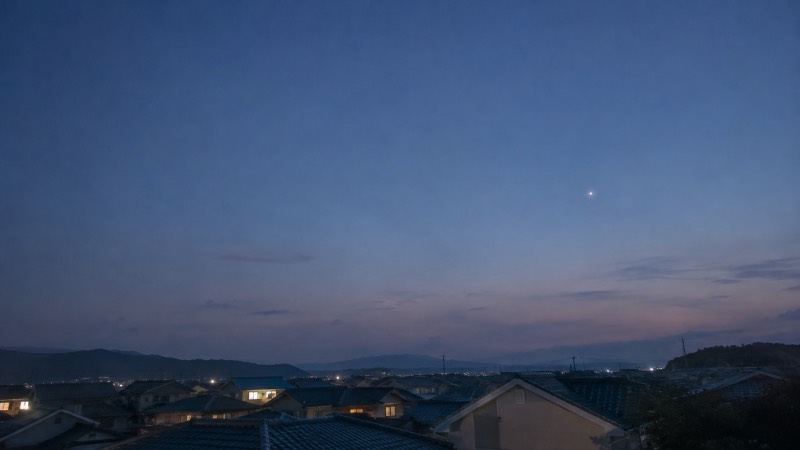
Why Venus Gets Mistaken for a UFO
Most very bright "stars" at dusk or dawn are Venus or Jupiter. How atmospheric turbulence and the autokinetic effect make them seem to move, and how to tell a planet.
ReadIf you see a UFO: how to record it
Read
What Orbs in Photos Really Are
How to identify round "orbs" in photos, based on known phenomena: lens flare, lens ghosts, out-of-focus blur and ball lightning.
Read
The March 3, 2026 Total Lunar Eclipse: The Facts
A total lunar eclipse seen across Japan. Its timing, why the Moon looks red, and whether the "bad omen" folklore holds up, checked against NAOJ announcements.
Read