
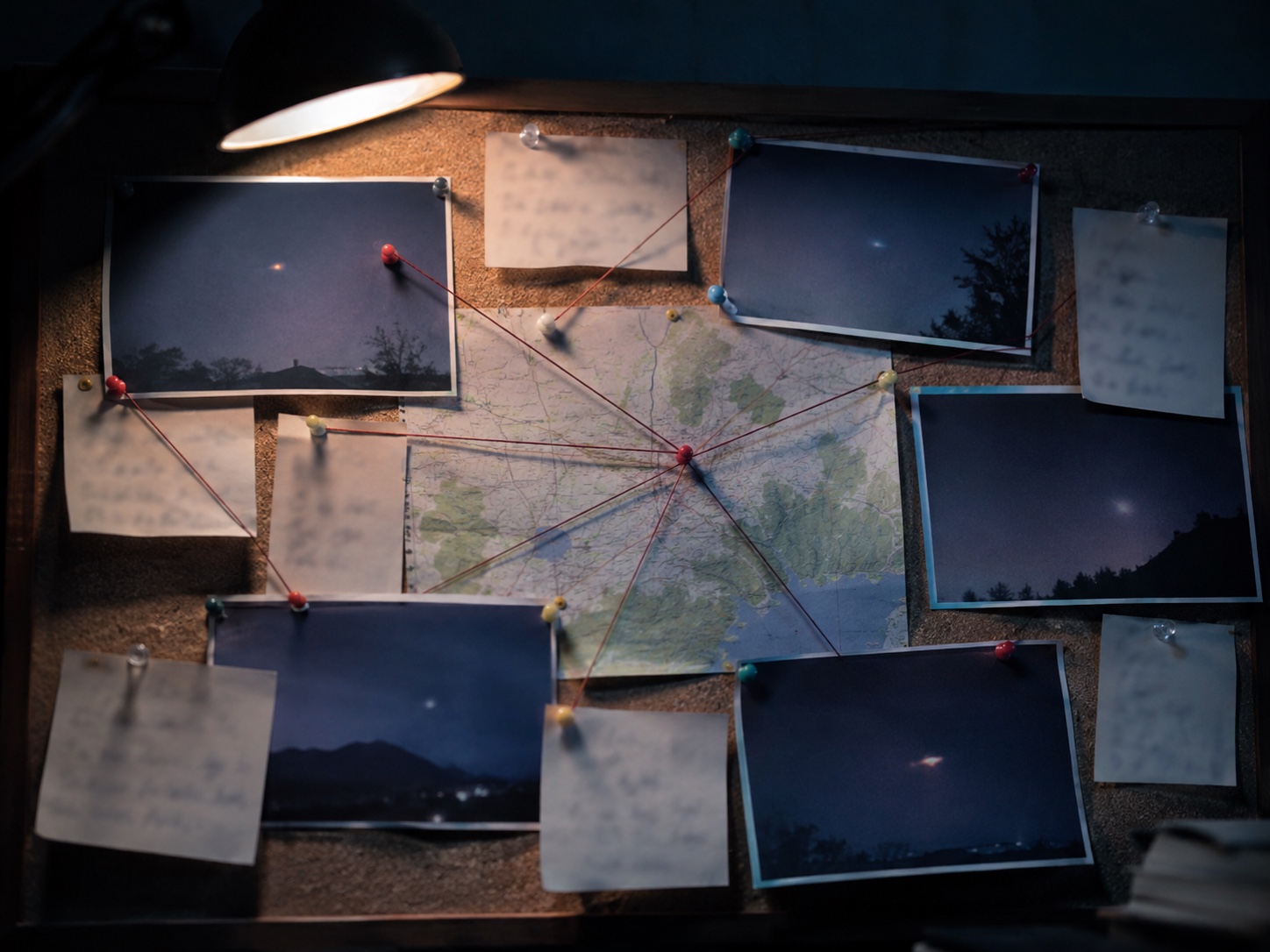
When you see something in the sky you can't identify, it's easy to think “that's a UFO.” What matters is to record it as fact before you decide anything. With a calm record, you can later compare it with known phenomena and work out what it was.
1. Stay calm and observe
Don't decide “it's a UFO.” Observe what you can actually see, as facts. Jumping to conclusions distorts what you record afterward.
2. Note the basic items
Date and time, direction (north, south, east, west), height (elevation angle, the angle above the horizon), duration, how it moved, color, brightness, and whether there was any sound. A note or voice memo on your phone is fine.
3. Photo tips
Keep the camera steady and, if you can, include something that shows scale, such as a building or a tree. Video or burst shots help when analyzing blinking and movement.
4. Compare it with known phenomena
Check it against common misidentifications: aircraft (blinking red and green lights), satellites and Starlink (in a line, at a constant speed), Venus (a bright point that doesn't move), balloons, lens flare and so on.
5. Keep a record and share it
You can share your images by posting them to this site's Sightings Board (in Japanese; posts are reviewed, and posting is free). Keep your record in a form that anyone can check later.
Where to report a UFO sighting
Official channels differ by country, and in most places there is no government office that takes reports from the general public. As of November 2026:
United States
AARO, the Defense Department's All-domain Anomaly Resolution Office, does not yet have a reporting form for the general public; it says it will announce one when available. Its online form is only for current or former US government employees, service members and contractors. Civilian pilots report to air traffic control. The FAA advises reporting to local law enforcement if life or property may be in danger.
Private groups (any country)
NUFORC, the National UFO Reporting Center (founded in 1974), takes reports through an online form on nuforc.org. MUFON, the Mutual UFO Network, takes reports online, and its volunteer field investigators may follow up. These are private organizations, not government bodies.
United Kingdom
The Ministry of Defence stopped investigating UFO reports in 2009, and no government body now collects them. Contact the police only if there is an immediate safety concern.
Canada
Transport Canada records aviation-related reports, including some UAP reports, in its CADORS occurrence database. A 2025 report by the government's Chief Science Advisor (the Sky Canada Project) recommended creating a dedicated public reporting service.
What makes a report useful
AARO's public guidance says the most useful data is recorded, time-stamped and geolocated, for both the observer and the object if possible, so it can be checked against air traffic, balloon and satellite tracking. In practice:
- Keep the original photo or video file. Its metadata (time, GPS position, camera settings) matters; screenshots and re-shared copies lose it.
- Record your own location, the direction you were facing, the object's height above the horizon, and how long you saw it.
- Note whether there were other witnesses, and write your impressions separately from what you actually observed.
- Check known explanations first. MUFON itself asks people not to report Starlink satellites or rocket re-entries as UFOs.
Share your images
You can post sighting images to the Sightings Board (posts are reviewed, and posting is free). The board is in Japanese.
For telling common misidentifications apart, see How to identify UFOs; for lines of lights, see How to spot Starlink; and for whether an image is genuine, see How to spot fakes.
FAQ
Where should I report a UFO sighting?+
In the US, AARO (the Defense Department's UAP office) had no public reporting form as of November 2026; civilian pilots report to air traffic control, and the FAA advises contacting local police if life or property may be in danger. Private groups such as NUFORC and MUFON accept reports from anyone online. The UK Ministry of Defence stopped investigating reports in 2009. In Canada, Transport Canada records aviation-related reports. Whatever channel you use, first record the sighting and check it against known phenomena.
What should I record?+
The basics are date and time, direction, height (elevation angle), duration, how it moved, color, brightness, and whether there was any sound. Writing down your impressions separately from the facts you observed makes cross-checking easier later.
Any tips for taking photos?+
Keep the camera steady and include something that shows scale, such as a building or a tree; this gives clues to distance and size. If possible, record video or burst shots so that blinking and movement can be seen.
UFO Kanteishi Exam, Grade 3
Grade 3 of the UFO Kanteishi Exam is free and needs no account. 20 questions check the basics of observing, recording and cross-checking.
To become a Licensed UFO Kanteishi, take Grade 2 (Official Guide + exam).