
Key points
- According to the forecast of the National Astronomical Observatory of Japan (NAOJ), the 2026 Geminids peak at about 23:00 JST on December 14 (14:00 UTC).
- In Japan, the Moon sets by about 21:00 JST on the night of the 14th, so moonlight will have little effect after that, and excellent observing conditions are expected.
- Forecast meteor rates vary, but at the busiest time, around 00:00–02:00 JST on the 15th, they are expected to reach about 60 per hour from a dark site.
- The Geminids tend to drop off sharply after the peak, so observing from the night before the peak to the early part of the peak night is considered the better choice.
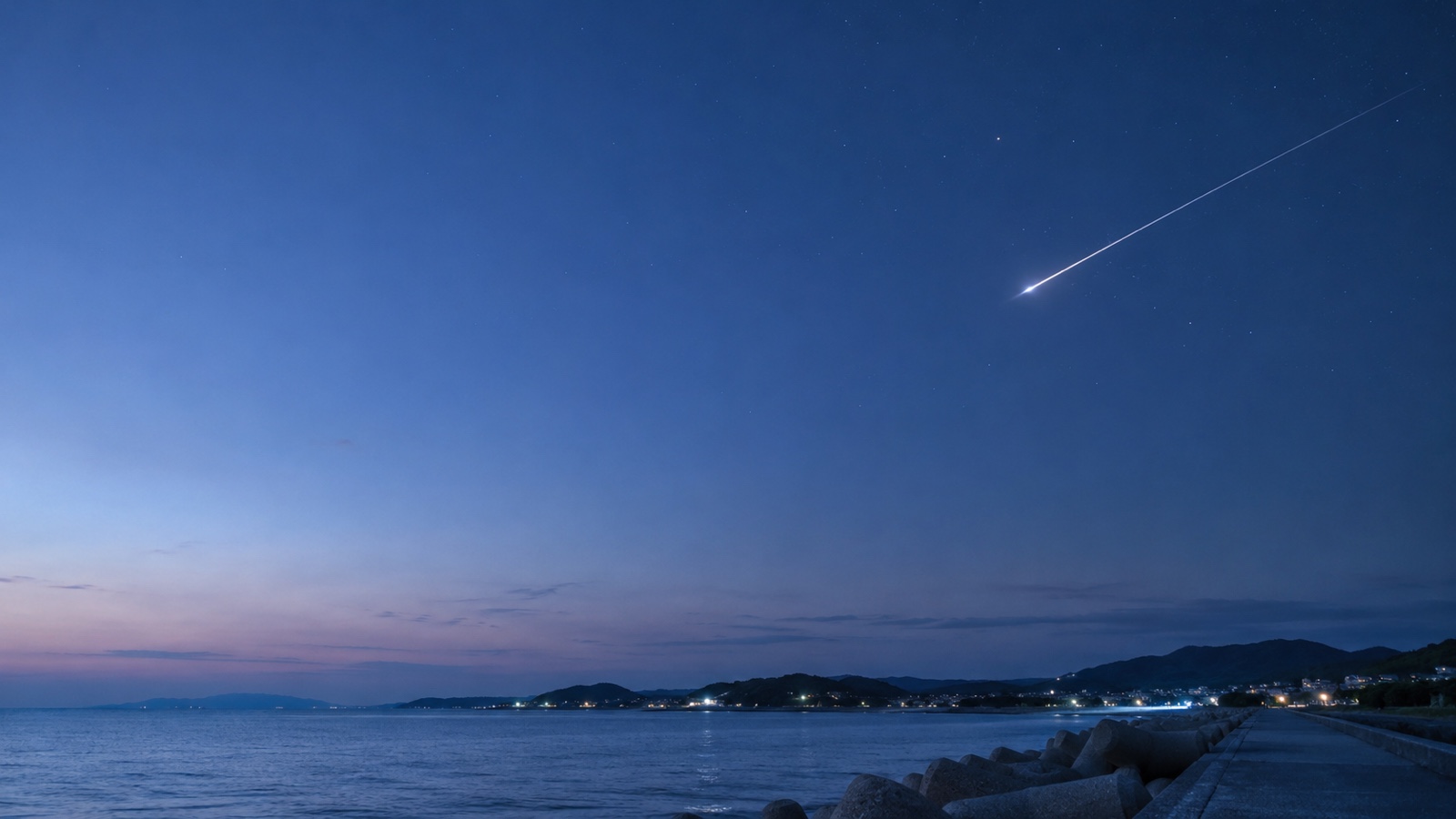
- A meteor vanishes in a straight line within seconds; also consider other known phenomena, such as satellites, which move at a constant speed for a long time, and aircraft, which blink as they go.
The Geminids are considered one of the "three major meteor showers," along with the Quadrantids and the Perseids, and they become active every December. Based on forecasts from the National Astronomical Observatory of Japan (NAOJ), this article sets out the 2026 peak date and time, the best viewing times, how to prepare, and how to avoid mistaking other lights for meteors. The numbers and times are only forecasts and will vary with your location and the weather. Times are for Japan (JST, UTC+9), with UTC added in parentheses.
When is the best time to see the 2026 Geminids?
According to NAOJ's forecast, the 2026 Geminid peak (the time of greatest activity) is at about 23:00 JST on December 14 (14:00 UTC). Around the peak, many meteors are expected from late night until dawn.
2026 is also considered a year with favorable moon conditions. In Japan, the Moon sets by about 21:00 JST (12:00 UTC) on the night of the 14th, so after that moonlight is unlikely to interfere, and a dark sky that is easy to observe is expected. The Moon's age will be about 6 days: a fairly thin moon, around half full.
The 2026 peak and moon conditions
Forecast meteor rates change through the night. NAOJ forecasts, for a dark site, 35–40 per hour at about 21:00 JST on the 14th, about 60 at the busiest time around 00:00–02:00 JST on the 15th, and around 40–55 toward dawn on the 15th. Around 30–35 are also expected from the previous night, the 13th, until dawn on the 14th. These are forecasts for ideal conditions; under the bright skies of a city, the number you actually see will be lower.
A sharp drop after the peak, and which nights to choose
The Geminids are said to drop off relatively sharply after the peak. So if you only have a limited number of nights, the advice is that choosing the night before through the early part of the peak night is better than shifting later than the peak.
Applied to 2026, with the peak at about 23:00 JST on the 14th, the main viewing window in Japan is from late night on the 14th until the early hours of the 15th. The highest rates are expected around 00:00–02:00 JST on the 15th, and a fair number are still expected toward dawn after that. On the other hand, it is safest to assume that rates will drop considerably once more than a day has passed since the peak.
How to choose your observing night
Direction, timing and staying warm
The point from which meteors appear to fly out is called the radiant; the Geminid radiant is in the constellation Gemini (near Castor). But meteors do not appear only in the direction of the radiant; they appear all over the sky. There is no need to keep looking in one direction; the basic approach is to take in as wide an area of sky as possible.
In terms of timing, viewing is said to be easiest from late night toward dawn, when the radiant is high. The best place to observe is somewhere as dark as possible, where streetlights and building lights do not enter your view. To see a wide area of sky, lying down on a ground sheet or similar also works well.
- Take in as wide an area as possible rather than one particular direction
- Choose a dark place where city lights and moonlight do not shine directly into your eyes
- Allow about 10–15 minutes for your eyes to adjust to the dark, and don't look at bright screens during that time
- December nights are cold, so prepare heavy warm clothing, gloves, hot drinks and so on
- A reclining chair or ground sheet reduces strain on your neck and lets you observe for longer
No binoculars or telescope needed
How meteors differ from fireballs, satellites and aircraft
Not every light you see while observing is a meteor. A non-blinking light that crosses the sky at a constant speed for a long time may be a satellite or the ISS (International Space Station), and a light moving slowly while blinking regularly may be an aircraft. A meteor is visible only briefly, within a few seconds from appearance to disappearance, and is characterized by moving fast in a nearly straight line and then vanishing.
An especially bright meteor is called a fireball. It can break up while burning and look like several points of light, or leave a glowing trail that lingers for a while after it fades. These are natural phenomena that can also occur during meteor shower activity, and they do not automatically mean an unidentified flying object.
Scroll the table sideways →
| What you saw | How long it is visible | How it moves | Main clues |
|---|---|---|---|
| Meteor (Geminids) | Generally within a few seconds | Moves fast in a nearly straight line, then vanishes | Does not blink and vanishes in an instant; appears all over the sky, not only near the radiant |
| Fireball (bright meteor) | A few seconds to a dozen or so seconds | Fast, in a roughly constant direction | Very bright; breakup or a glowing trail may be visible |
| Satellites and the ISS | Tens of seconds to a few minutes | Crosses the sky at a constant speed | Moves without blinking; does not stop suddenly or reverse |
| Aircraft | Several minutes or more | Moves relatively slowly | Blinks regularly; lights of several colors may be visible |
How to check a light you saw afterward
Noting the date and time, direction, elevation and how long a light was visible makes it easier to check afterward whether it was a meteor. During a meteor shower's active period, a light that vanished in a straight line within a short time was most likely a meteor, and by cross-checking against star chart apps and public information from NAOJ and others, you can separate it from other candidates such as satellites and planets.
If you conclude that something was "unidentified" without any record, you lose the clues needed to cross-check later. The basic approach is to cross-check what you saw against known phenomena one by one, and to treat only what remains unexplained at the end, carefully, as unidentified. "Unidentified" means not yet identified; it does not automatically mean extraterrestrial.
Four things to record
FAQ
When do the 2026 Geminids peak?+
According to NAOJ's forecast, the peak is at about 23:00 JST on December 14, 2026 (14:00 UTC). The highest rates are expected around 00:00–02:00 JST on the 15th, reaching about 60 per hour from a dark site. The numbers and times are forecasts and will vary with your location and the weather.
Can I still see them after the peak?+
The Geminids are said to drop off relatively sharply after the peak. A fair number are expected until dawn after the peak night, but it is safest to assume that rates will drop considerably once more than a day has passed. If your observing nights are limited, choosing the night before through the early part of the peak night is considered the better option.
Can I tell a Geminid meteor from a UFO?+
A meteor is visible only briefly, within a few seconds from appearance to disappearance, moving fast in a nearly straight line and then vanishing. Consider other known phenomena too: a non-blinking light moving at a constant speed for a long time is likely a satellite, and a light moving while blinking regularly is likely an aircraft. During the active period, a light that vanished in an instant was most likely a meteor.
Do I need any equipment to observe?+
Meteor showers are basically observed with the naked eye; binoculars and telescopes have narrow fields of view and are considered unsuitable. No special equipment is needed. December nights are cold, so heavy warm clothing, gloves, hot drinks and a reclining chair or ground sheet will help you observe for longer.
UFO Kanteishi Exam, Grade 3
Free, no account needed. 20 questions on observing, recording and cross-checking. Pass and get a certificate with a verifiable number.
To become a Licensed UFO Kanteishi, take Grade 2 (Official Guide + exam).
Related reading
Fireballs vs. UFOs: How to Tell
Most bright balls of fire crossing the sky are fireballs (bright meteors). Breakup, glowing trains and delayed sound: what to look for to tell them from UFOs.
Read
5 Things to Check About a Light in the Night Sky
Five observation points for identifying lights in the night sky. Based on NAOJ's list, a step-by-step guide and table for planets, satellites, contrails and more.
Read
A Silent Light Crossing the Sky May Be the ISS
A silent, steady light moving straight across the night sky may be the ISS, orbiting about 400 km up every 90 minutes. How to tell it from aircraft and confirm with a forecast.
Read