
Key points
- The ISS circles Earth at an altitude of about 400 km, once every 90 minutes or so. It reflects sunlight and appears as a bright light that does not blink.
- It is mainly visible for about two hours after sunset and before sunrise, because sunlight still reaches high altitudes even when it is night on the ground.
- According to JAXA's guidelines, a silent light that does not blink and moves in a straight line suggests a satellite or the ISS, while blinking or red and blue colors suggest an aircraft.
- A light that does not blink is not necessarily the ISS. There are hundreds of satellites orbiting Earth.
- By cross-checking the date, time, direction and elevation angle of your sighting against a visibility forecast (such as JAXA's "Kibo wo Miyou"), you can confirm whether it was the ISS.
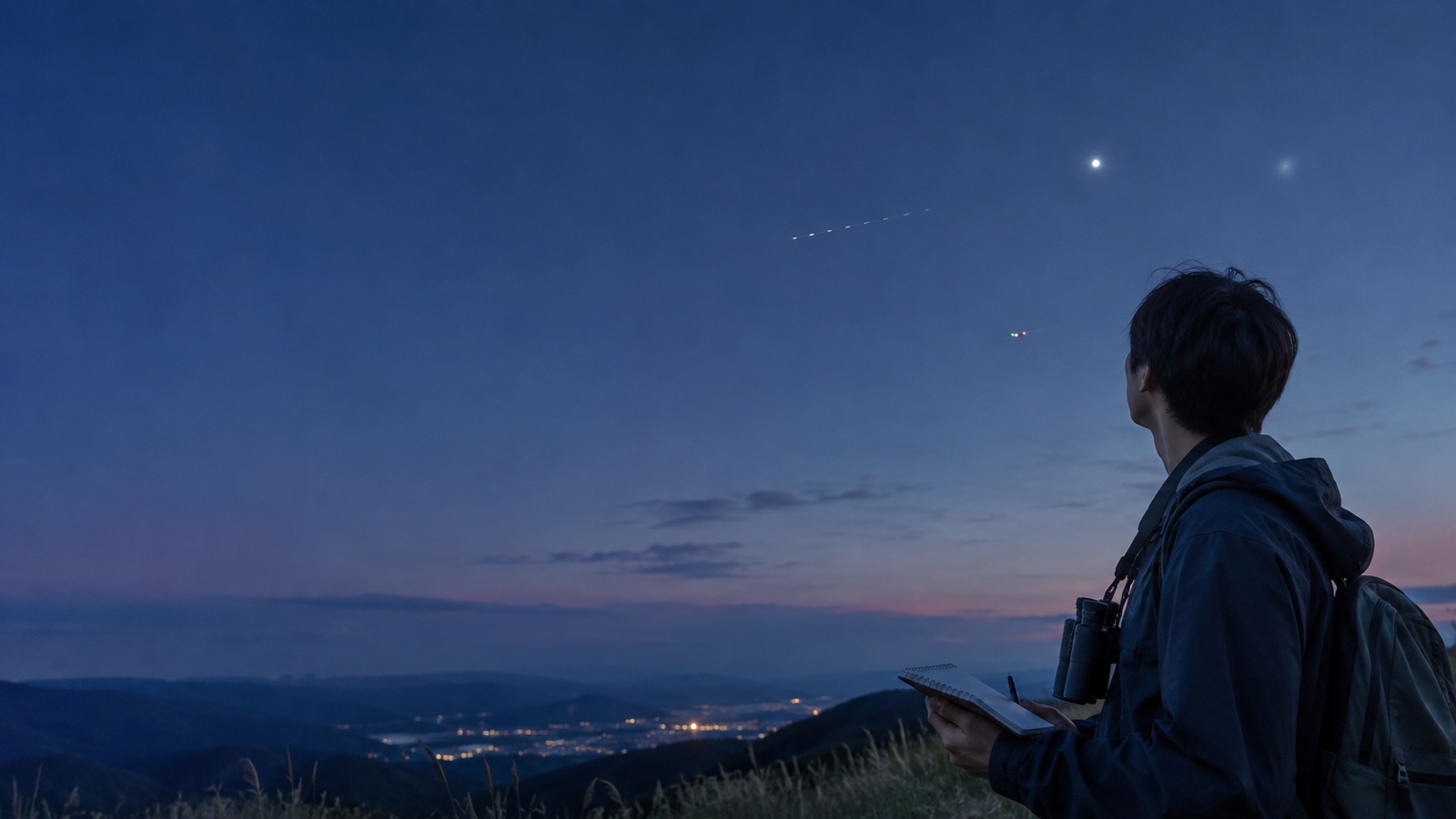
Most silent, bright lights that cross the night sky in a straight line at a constant speed without blinking are the International Space Station (ISS). It takes several minutes to cross, and it can disappear from view partway when it passes behind buildings or clouds.
The ISS orbits about 400 km (about 250 miles) above the ground and circles Earth in about 90 minutes. In good conditions it is clearly visible to the naked eye, and its movement has three characteristic features: it does not blink, it makes no sound, and it moves in a straight line. These are the identification clues explained in official information from JAXA (the Japan Aerospace Exploration Agency).
Based on primary sources, this article explains why the ISS shines in the night sky, how to tell it apart from aircraft and other satellites, and how to check afterward whether the light you saw was the ISS.
What is the ISS? About 400 km up, once around Earth in about 90 minutes
The ISS (International Space Station) is a crewed research facility built about 400 km above the ground. It is about the size of a soccer field and travels fast enough to circle Earth in about 90 minutes. Kibo, the experiment module developed by Japan, is also part of the ISS.
An altitude of 400 km is far above the height at which airliners fly (about 10 km, or roughly 33,000 feet). It is still visible to the naked eye because it shines by reflecting sunlight. The ISS does not give off light itself; like the Moon or Venus, it looks bright because it reflects sunlight.
Basic data
Why it shines in the night sky
The ISS is mainly visible during two windows of about two hours each: after sunset and before sunrise. This is because it shines by reflecting sunlight. JAXA-related explanations describe these windows as times when "it is night on the ground, but still daytime 400 km up."
In other words, while we on the ground are in darkness, sunlight is still falling on the ISS in its high orbit, and that reflected light is what we see from the ground as a bright point. In the middle of the night, when the sky is fully inside Earth's shadow, sunlight does not reach the ISS and it does not appear to shine.
When visible, it is said to be as bright as Jupiter in good conditions (about magnitude −2), and it crosses the night sky slowly as a bright point, more distinct than a first-magnitude star.
How to tell: blinking, sound, color and movement
Whether a light crossing the sky is the ISS (or another satellite) or an aircraft can be judged from several features. JAXA's FAQ explains that a bright light gliding smoothly across the sky without blinking may be a satellite (including the ISS), while a light that blinks or is red or blue may be an aircraft.
Scroll the table sideways →
| Feature | ISS / satellites | Aircraft |
|---|---|---|
| How it shines | Steady, no blinking | Red, blue or other lights blink |
| Color | A steady, whitish light | Mixed colors such as red and blue |
| Sound | None | Engine noise if it is close |
| Movement | Glides smoothly in a straight line | May turn or climb and descend |
However, there are hundreds of satellites orbiting Earth. Not every light that moves in a straight line without blinking is the ISS; it could be another satellite. To say for certain that "it was the ISS," you need to cross-check with a forecast, as explained next.
A first check you can do on the spot
Confirming afterward: check a visibility forecast
From the features you saw on the spot, you can only say that it was "probably the ISS." To confirm it, use a visibility forecast. When and in which direction the ISS will be visible can be calculated in advance, and JAXA points people to sources such as "#Kibo wo Miyou" ("Let's See Kibo," on its KIBO Space Broadcasting Station site, in Japanese) for viewing forecasts.
JAXA's FAQ explains that, to check whether a flying object you saw was the ISS, you can look up past visibility information: if there is a pass that matches the date and time, azimuth and elevation angle of your observation, it was probably the ISS. If nothing matches, it was not the ISS.
- 1Note the date and time, the direction in which it appeared, its height in the sky (elevation angle) and the direction it moved
- 2Check the visibility forecast for that location and time on a source such as "Kibo wo Miyou"
- 3If the date, time, direction and elevation angle match, the light you saw was most likely the ISS
- 4If they don't match, consider other satellites or other phenomena
The next time you want to watch on a clear night, the same forecast lets you know in advance when and in which direction it will appear, so you can be ready. If a bright light that does not blink glides into view at the forecast time, it is very likely the ISS.
Summary of this page
Test your identification skills: Grade 3 (free)
Check in order whether it blinks, whether it makes a sound and whether it moves straight, then confirm with a forecast at the end. This procedure is the basic way to get closer to identifying a light you saw in the sky. Not jumping to conclusions about something unidentified, and checking one thing at a time, is itself the foundation of identification.
Grade 3 of the UFO Kanteishi Exam is free and requires no registration. In a question format, it lets you test the kind of everyday identification knowledge covered in this article. To be able to sort things out calmly when you come across a light in the night sky, start with Grade 3.
FAQ
Can you see the ISS with the naked eye?+
Yes. According to JAXA, in good conditions it is as bright as Jupiter (about magnitude −2) and looks like a single light that does not blink, slowly crossing the sky. The best times to watch are mainly the two windows of about two hours each after sunset and before sunrise.
How can I tell the ISS from an aircraft?+
JAXA's FAQ explains that a bright light gliding smoothly across the sky without blinking may be a satellite (including the ISS), while a light that blinks or is red or blue may be an aircraft. Whether there is any sound, and whether it moves in a straight line, are also clues.
Can I check whether the light I saw was the ISS?+
Yes. Note the date and time, the direction in which it appeared, its height in the sky (elevation angle) and the direction it moved, then compare them with a visibility forecast such as "Kibo wo Miyou." JAXA's FAQ explains that if there is visibility information matching the date and time, azimuth and elevation angle, the flying object you saw was probably the ISS.
Is a light that doesn't blink always the ISS?+
No. There are hundreds of satellites orbiting Earth, and not every light that moves in a straight line without blinking is the ISS. To confirm that it was the ISS, you need to cross-check the date, time, direction and elevation angle against a visibility forecast.
How fast does the ISS appear to move?+
The ISS circles Earth at an altitude of about 400 km, once every 90 minutes or so. In the sky it looks like a point brighter than a first-magnitude star gliding across over several minutes without blinking. It can disappear from view partway when it passes behind buildings or clouds.
UFO Kanteishi Exam, Grade 3
Free, no account needed. 20 questions on observing, recording and cross-checking. Pass and get a certificate with a verifiable number.
To become a Licensed UFO Kanteishi, take Grade 2 (Official Guide + exam).
Related reading
5 Things to Check About a Light in the Night Sky
Five observation points for identifying lights in the night sky. Based on NAOJ's list, a step-by-step guide and table for planets, satellites, contrails and more.
Read
Identifying Planes Overhead with Flightradar24
How to check the flight, aircraft type and altitude of a plane overhead on Flightradar24, and how to recognize aircraft by their red, green and white lights.
Read