

Key points
- Flightradar24 collects ADS-B data (GPS-based position information that aircraft broadcast) through what it says are more than 50,000 receivers worldwide, and shows flight numbers, aircraft types, altitudes and more in near real time.
- The basic feature of tapping an aircraft icon overhead on the map is free; the AR feature, where you point your camera at the sky, is described as part of a paid premium plan.
- Position lights stay on steadily: green on the right wingtip, red on the left wingtip and white on the tail. Anti-collision lights flash, as red beacons or white strobes.
- Red, green and white blinking lights moving in a steady direction are most likely an aircraft; hovering or sudden changes of direction point to something else.
- Not showing up in the app does not make it a UFO. Weigh several clues, including the possibility of aircraft that aren't displayed, drones, stars and so on.
Sometimes you see a slowly moving light in the night sky or at dusk. If it blinks, or looks like a mix of red and green, many people wonder what it is. Most of the time, it is an aircraft. And for an aircraft flying overhead, a service called Flightradar24 can, in a good share of cases, tell you which flight it is and where it is flying from and to.
This page explains how Flightradar24 works and how to use it, and what you need to know about aircraft lights to judge whether the light really is an aircraft, as far as could be confirmed in primary sources. It is a starting point for identifying lights in the sky one by one through a process of elimination.
What Flightradar24 is and how it works
Flightradar24 is a real flight-tracking service that shows the positions of aircraft flying around the world on a map in near real time. Tap a small aircraft icon on the map and it shows the flight number, origin, destination, aircraft type, altitude, speed, heading and so on.
Its main data source is a system called ADS-B (Automatic Dependent Surveillance–Broadcast). Aircraft work out their own position by GPS and continuously broadcast it by radio. According to Flightradar24's own explanation, it receives these signals with ground receivers that number more than 50,000 worldwide, and displays them combined with flight schedules and other data.
Some older aircraft and military aircraft that do not transmit ADS-B signals are not shown, or are shown using a method called MLAT, which estimates position from multiple receivers. In other words, note that "not in the app" does not necessarily mean "not an aircraft."
A term worth knowing
How to look up an aircraft overhead
You can use it in a web browser on a computer or in the smartphone app. Basic checks can be done for free. On a smartphone, the steps are as follows.
- 1Open the Flightradar24 app (or open flightradar24.com in a browser).
- 2Among the aircraft icons on the map, look for one close to the direction and position overhead.
- 3If you allow location access, your current location is shown on the map, making it easier to find nearby aircraft.
- 4Tap the icon you are interested in to see details such as the flight number, origin, destination, aircraft type, altitude and speed.
- 5Check whether the altitude and heading match how the light you can see is actually moving.
There is also an AR (augmented reality) feature that overlays flight information on the image when you point your phone's camera at the sky. However, identifying aircraft overhead through the camera is described as a feature of the paid premium plans. Within the free tier, the basic method is to compare position and altitude on the map.
How to match them up
How to recognize aircraft lights in the first place
Before checking Flightradar24, it saves time if you can first guess that "this looks like an aircraft." Aircraft exterior lights follow rules for color and how they are lit, and knowing these features makes the judgment easier.
Broadly, there are "position lights" (navigation lights), which show which way the aircraft is facing, and "anti-collision lights," which make it easier to see from a distance. Position lights stay on steadily, and the rules specify green on the right wingtip, red on the left wingtip and white on the tail. Anti-collision lights, by contrast, flash: red flashing lights (beacons) and bright white strobes are used.
Scroll the table sideways →
| Light | Color | How it is lit | Purpose |
|---|---|---|---|
| Position light (right) | Green | Steady | Right wingtip; shows direction of travel and which way the aircraft is facing |
| Position light (left) | Red | Steady | Left wingtip; shows direction of travel and which way the aircraft is facing |
| Position light (tail) | White | Steady | Tail; shows the aircraft's position when seen from behind |
| Beacon | Red | Flashing (rotating) | Visibility from a distance; warning that, for example, the engines are running |
| Strobe | White | Bright flashes | Improves visibility from a distance, for example in flight |
So if a light is moving slowly in a steady direction, with steady red and green lights plus flashing white strobes, it is most likely an aircraft. Conversely, hovering in place, sudden changes of angle, or colors that change in a multicolored way are clues to consider a drone or something else.
The key to the judgment
When you can't tell, and things to watch for
At long distances, colors and blinking become hard to make out. Stars and planets (such as Venus) do not move, or move only very slowly, so they can be distinguished from lights that blink and move. Satellites and the International Space Station (ISS) are characterized by not blinking and gliding along at a steady brightness.
Not every light that doesn't appear on Flightradar24 is a mystery. As noted above, some aircraft may not be displayed, and explanations other than aircraft, such as balloons, drones or reflections of lights on the ground, always need to be considered. It is important not to draw a firm conclusion from one method alone, but to weigh several clues together.
If you cannot identify it, the honest approach is to leave it as "unidentified" rather than force a conclusion. "Unidentified" refers to a state in which the object is not known; it does not mean extraterrestrial.
FAQ
Is Flightradar24 free to use?+
The basic feature of tapping an aircraft icon on the map to see the flight number, origin, destination, aircraft type, altitude and more is free. Features such as AR, which identifies aircraft overhead when you point your phone's camera at the sky, are described as part of the paid premium plans.
How can I find out which flight is flying overhead?+
Open the app or the official website, find an aircraft icon near your current location on the map, and tap it. Compare the direction, altitude and heading of the light you can see with the information shown for that aircraft to confirm that they match.
How do I recognize aircraft lights?+
Position lights stay on steadily: green on the right wingtip, red on the left wingtip and white on the tail. Anti-collision lights flash, as red flashing beacons or white strobes. If red, green and white blinking lights are moving slowly in a steady direction, it is most likely an aircraft.
Is a light that doesn't show up on Flightradar24 a UFO?+
Not necessarily. Some aircraft that do not transmit ADS-B signals may not be displayed, and it could also be a drone, a balloon, a star, a satellite or something else. Stick to the fact that it doesn't appear in the app (that is, it is unidentified), and weigh several clues together.
UFO Kanteishi Exam, Grade 3
Free, no account needed. 20 questions on observing, recording and cross-checking. Pass and get a certificate with a verifiable number.
To become a Licensed UFO Kanteishi, take Grade 2 (Official Guide + exam).
Related reading

5 Things to Check About a Light in the Night Sky
Five observation points for identifying lights in the night sky. Based on NAOJ's list, a step-by-step guide and table for planets, satellites, contrails and more.
Read
A Silent Light Crossing the Sky May Be the ISS
A silent, steady light moving straight across the night sky may be the ISS, orbiting about 400 km up every 90 minutes. How to tell it from aircraft and confirm with a forecast.
Read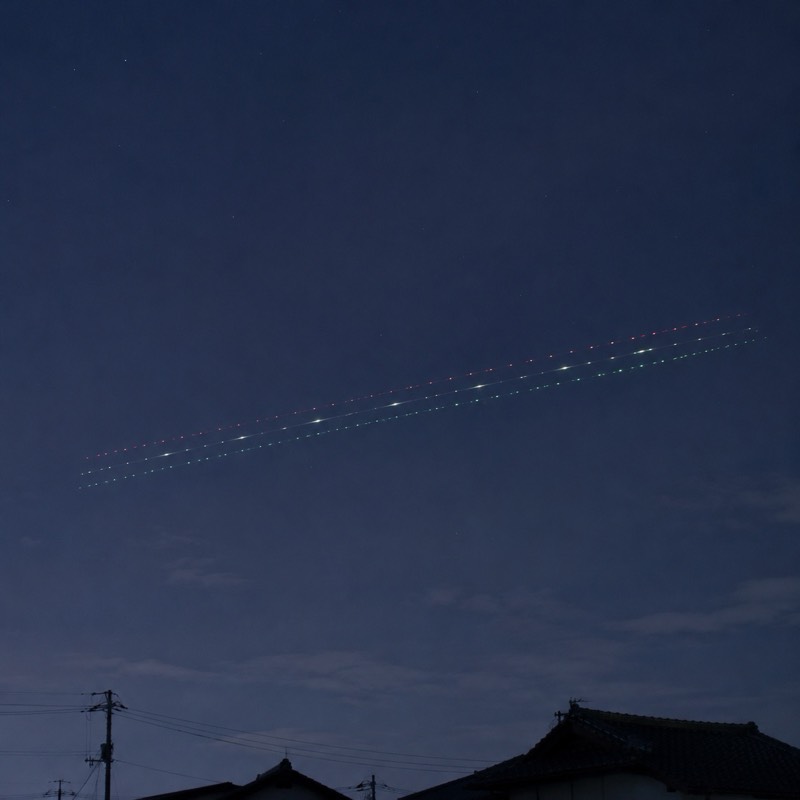
Drone or Aircraft? Telling Night Lights Apart
Use Japan's night-flight rules for drones, the colors and positions of aircraft navigation and anti-collision lights, and movement to identify a light in the night sky.
Read