
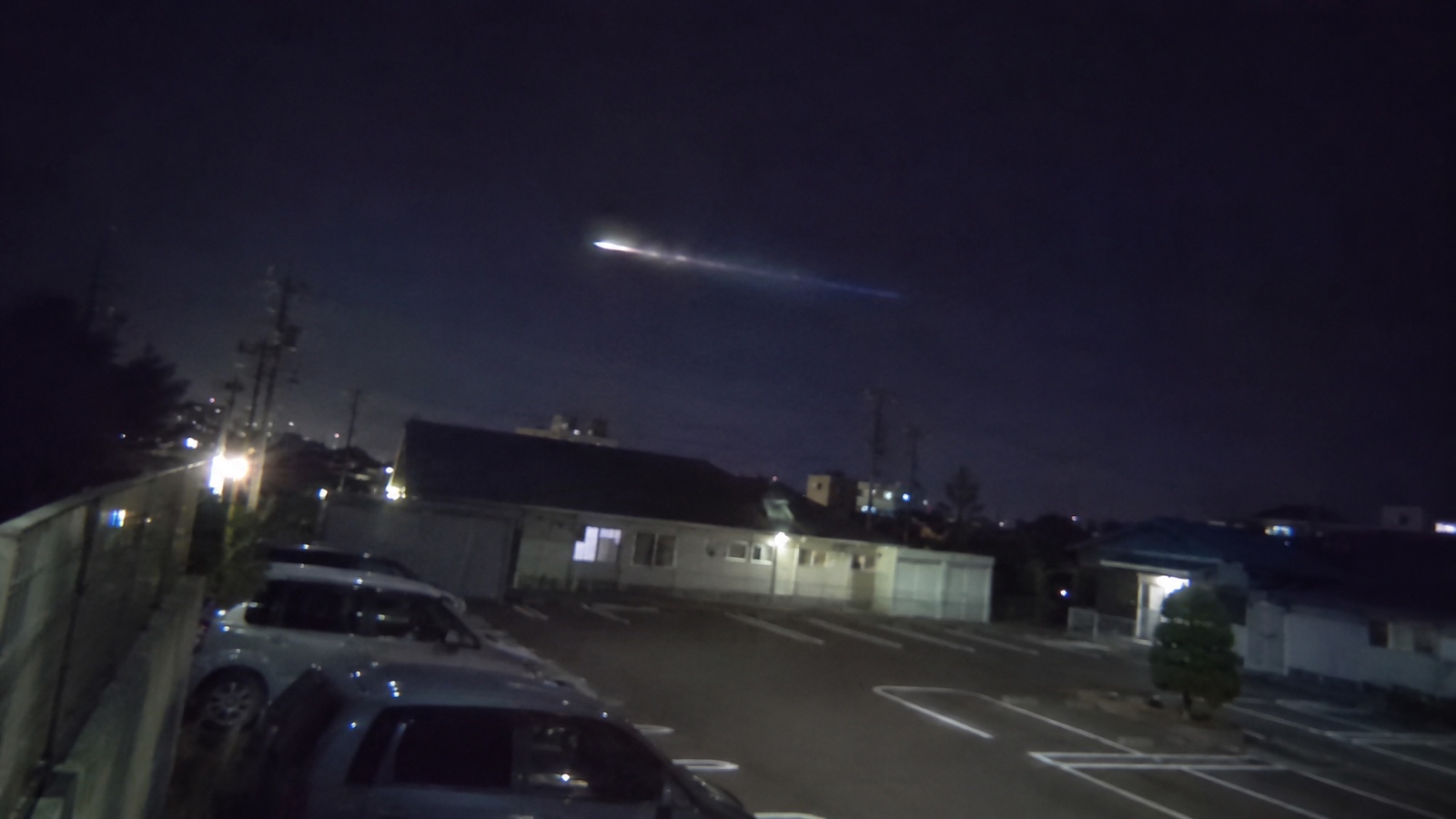
Key points
- A fireball that moves slowly over tens of seconds to several minutes while breaking into several pieces may be rocket debris or a satellite reentering the atmosphere.
- Reentering objects are said to enter the atmosphere at an altitude of about 120 km and begin to melt and break apart from aerodynamic heating in the mesosphere (around 80 km).
- An ordinary meteor disappears within seconds, whereas a reentry can last tens of seconds to several minutes and crosses the sky slowly. This is said to be the difference in appearance.
- Uncontrolled reentries of the core stage of China's Long March 5B rocket were reported repeatedly, including in 2020, 2021 and 2022.
- Cross-checking your observation notes against prediction information from sources such as the National Astronomical Observatory of Japan, and against news reports, makes it easier to confirm what you saw.
When you see "a line of lights" or "a fireball slowly breaking apart" crossing the night sky, you may wonder whether it is a falling rocket or a UFO. Light that moves slowly over tens of seconds to several minutes and streams across the sky in several pieces may be rocket debris or a satellite reentering the atmosphere. "Unidentified" here means the object has not been identified; it does not mean extraterrestrial. This article sets out the features of how reentries look and examples of reentries that were actually reported, based on the facts.
If you see a light slowly breaking apart as it moves
An ordinary meteor disappears within seconds, but a light that crosses the sky slowly while breaking into several lights is said to be typical of an artificial object reentering the atmosphere. Because a reentering object melts and breaks apart as it falls, the fireball may not stay in one piece and can look like a string of fragments streaming across the sky.
So the first clues for telling a meteor from a reentry are to recall "how long it was visible" and "whether it was a single light or broke apart."
What a reentry typically looks like
What is the reentry of rocket debris or a satellite?
Spent rocket stages and old satellites eventually fall back into Earth's atmosphere. A reentering object is said to enter the atmosphere at an altitude of about 120 km (about 75 miles), begin to melt from aerodynamic heating in the mesosphere (around 80 km, or about 50 miles), and break apart as it falls. The light it gives off at this stage looks like a fireball from the ground.
SpaceX's Starlink satellites are reported to be reentering and turning into fireballs somewhere in the world almost every day, and in one case a reentry was observed as a "light show" lasting about two minutes. Note that the "Starlink train," a line of satellites seen shortly after launch, is caused by the satellites reflecting sunlight and is a different phenomenon from reentry. Be careful not to confuse the two.
Not always visible over Japan
How it differs from meteors and fireballs (speed and duration)
The keys to telling them apart are speed, duration and whether it breaks apart. Ordinary meteors and bright fireballs are fast and disappear within a few seconds to a dozen or so seconds. A reentering artificial object, by contrast, crosses the sky slowly, can last tens of seconds to several minutes, and is characterized by streaming along in several fragments.
Scroll the table sideways →
| Candidate | Speed and movement | Duration | Appearance |
|---|---|---|---|
| Reentry of rocket debris or a satellite | Crosses the sky slowly | Tens of seconds to several minutes | May break into several pieces as it moves |
| Meteor or fireball | Streaks across fast, all at once | A few seconds to a dozen or so seconds | Usually a single light that trails a tail and fades |
| Satellite (ordinary pass) | Moves among the stars at a constant speed | A few minutes | A point of light that does not blink, with nearly constant brightness |
| Aircraft | Moves in a straight line | A few minutes | Has blinking lights such as red and green |
These are only rough guides, however. How things look changes with observing conditions, so the basic approach is not to decide from a single feature but to compare several points and judge carefully.
Reported reentries of Chinese rocket debris
Uncontrolled reentries of large rockets have made the news many times. Cases in which the core stage of China's large Long March 5B rocket reentered without control were reported repeatedly, including in 2020, 2021 and 2022.
- May 2020: The core stage reentered without control, and there were reports that surviving debris fell in Côte d'Ivoire and damaged buildings.
- May 2021: It was reported to have come down near the Maldives, in the Indian Ocean.
- July 2022: It was reported to have come down in the Sulu Sea near Palawan in the Philippines.
News reports have said that with uncontrolled reentries like these, it is hard to pin down where the object will fall until a few hours beforehand, and that surviving debris could be scattered over an area about 2,000 km long and about 70 km wide (about 1,200 by 45 miles). The reentry of a large object can be observed as a glowing light like a fireball.
How to record your observation and cross-check it
Even if you cannot identify it on the spot, if you record what you observed, you can confirm it later by cross-checking against prediction information and news reports. The following steps help.
- 1Record the date and time (to the second, if possible), the direction and the height in the sky (a rough angle above the horizon).
- 2Check the duration. Whether it vanished within seconds or moved slowly for tens of seconds or more is an important clue.
- 3Recall whether it was a single light or broke into a string of fragments.
- 4If possible, take a photo or video, and also record how the sky looked and any landmarks on the ground.
- 5Check prediction information from sources such as the National Astronomical Observatory of Japan, and whether there were news reports of a reentry or fall at that time, and cross-check them against your record.
Check these first
Even if you cannot identify something on the spot, that does not mean it is extraterrestrial. The basic approach is to cross-check what you saw against known phenomena one by one, and to treat only what remains unexplained at the end, carefully, as unidentified.
FAQ
What is a light that moves slowly while breaking apart?+
A light that crosses the sky slowly over tens of seconds to several minutes and streams along in several fragments may be rocket debris or a satellite reentering the atmosphere. Because a reentering object melts and breaks apart as it falls, the fireball may not stay in one piece and can appear to split up. If it was brief and a single light, it was most likely a meteor.
What does rocket debris look like when it reenters?+
It has been reported to glow as it crosses the sky slowly, streaming along while breaking into smaller pieces. It can last tens of seconds to several minutes, longer than an ordinary meteor, which disappears within seconds. In one case, a Starlink satellite reentry was observed as a "light show" lasting about two minutes.
How is a shooting star different from a reentry?+
An ordinary shooting star is fast and disappears within a few seconds to a dozen or so seconds. A reentering artificial object, by contrast, crosses the sky slowly, can last tens of seconds to several minutes, and is characterized by streaming along in several fragments. Speed, duration and whether it breaks apart are the main clues for telling them apart.
Is falling rocket debris dangerous?+
The chance of it hitting any particular person is said to be extremely low, but there are real cases of surviving debris reaching the ground. In 2020, there were reports that debris from a Long March 5B fell in Côte d'Ivoire and damaged buildings. News reports have said that with uncontrolled reentries it is hard to pin down where the object will fall until a few hours beforehand, and that surviving debris could be scattered over a wide area.
UFO Kanteishi Exam, Grade 3
Free, no account needed. 20 questions on observing, recording and cross-checking. Pass and get a certificate with a verifiable number.
To become a Licensed UFO Kanteishi, take Grade 2 (Official Guide + exam).
Related reading

Fireballs vs. UFOs: How to Tell
Most bright balls of fire crossing the sky are fireballs (bright meteors). Breakup, glowing trains and delayed sound: what to look for to tell them from UFOs.
Read
5 Things to Check About a Light in the Night Sky
Five observation points for identifying lights in the night sky. Based on NAOJ's list, a step-by-step guide and table for planets, satellites, contrails and more.
Read