
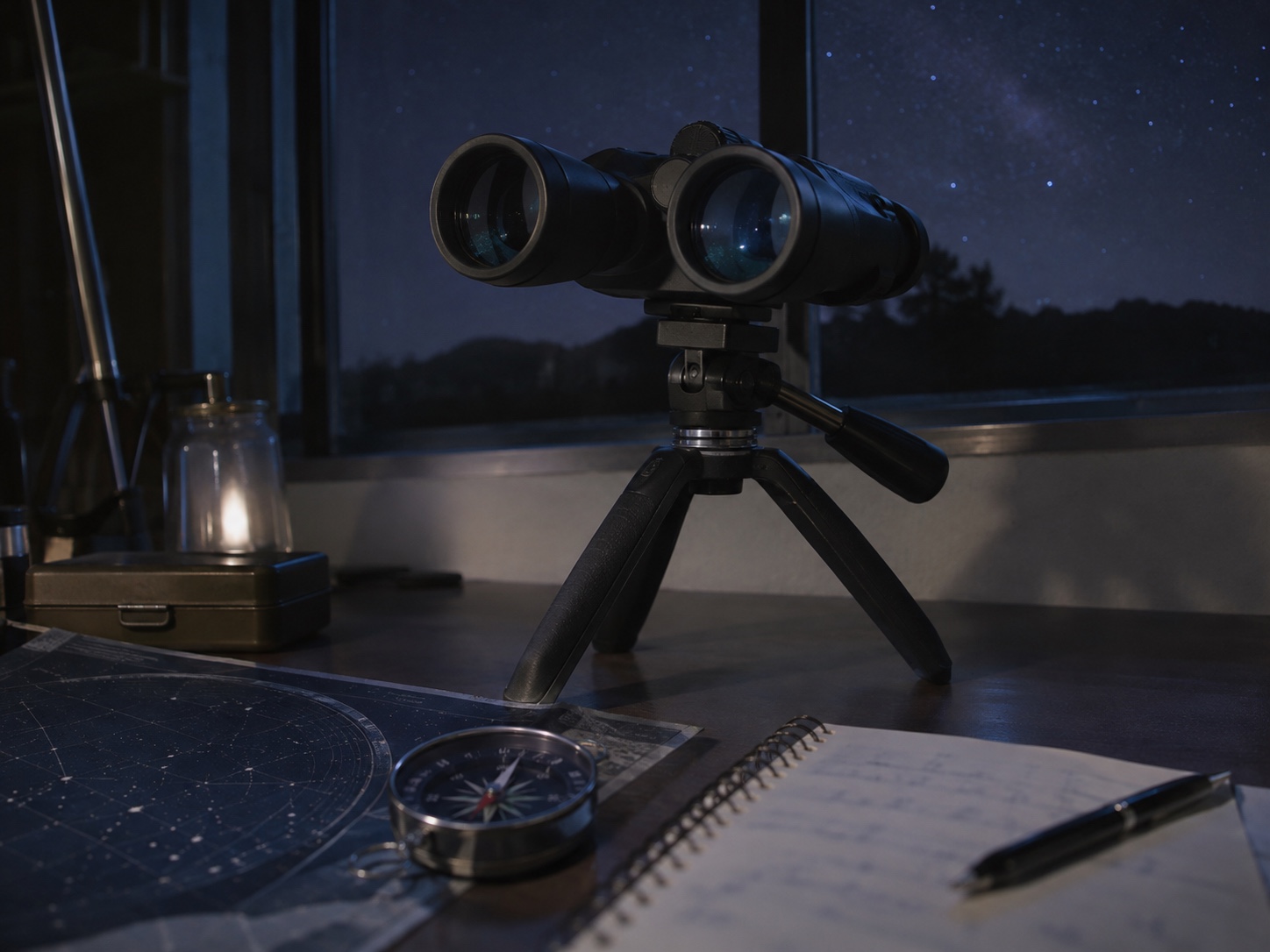
Key points
- UFO stands for "unidentified flying object" (a flying object whose identity is unknown). It does not mean an alien spacecraft.
- A research project can be built around the steps "observe → record → cross-check what it is → write it up."
- Based on the National Astronomical Observatory of Japan, the useful things to record are the date and time, duration, direction, height, brightness and speed of movement.
- You can do it without special equipment: notes, a smartphone clock, a star chart app and the free features of Flightradar24.
- Most lights in the sky are known to be explained by known phenomena such as planets, satellites and aircraft.
In Japan, schoolchildren often do an independent research project ("jiyu kenkyu") over the summer vacation. If you want to make UFOs or space the theme, trying to find out whether aliens or famous incidents are real tends to lead to questions you cannot check. An easier approach is to observe and record ordinary lights in the sky yourself and work out what they are. UFO stands for "unidentified flying object" (a flying object whose identity is unknown); it does not mean an alien spacecraft. Gathering clues to identify a light whose identity is not yet known is itself a good theme for inquiry based on observation.
Ways to turn UFOs and space into a research project
UFOs and space are broad subjects, so it is easier to start by narrowing down to something you can check with your own hands. Lights in the sky that you can actually observe and record are a typical example. Most bright or moving lights in the sky are known to be explainable phenomena such as planets, satellites, aircraft and contrails.
So set your research question as "what is each light I see in the sky?" and identify them one by one through observation and cross-checking. US government agencies and NASA call such unidentified phenomena UAP (unidentified anomalous phenomena). It is also worth making clear at the start of the project that "unidentified" means not yet identified, and does not mean extraterrestrial.
How to set your research question
Example themes: observe lights in the sky and find out what they are
Here are some specific themes you could use. They all share the same flow: observe and record lights seen at night or in the evening, then cross-check what they are afterward.
- Observe a very bright, star-like light seen in the evening or before dawn, and find out whether it is a planet (such as Venus).
- Record a light that crosses the night sky silently in a straight line, and check whether it is a satellite or the International Space Station (ISS).
- Record a light that flies while blinking, and cross-check on Flightradar24 whether it is an aircraft.
- Observe the same part of the sky at the same time for several days, and compare how the lights change.
It has been reported that the Hoshino Village Star Culture Center in Hoshino, Yame City, Fukuoka Prefecture (in southern Japan) created a checklist for identifying strange lights and UFOs in the sky, where you answer "yes" or "no" about the date and time, color, shape, movement and so on. Points of view like these can also help you shape your theme.
How to keep observation records (date and time, direction, height, photos)
In a research project it is fine not to know what something is on the spot. What matters is leaving a record that you can cross-check later. The National Astronomical Observatory of Japan (NAOJ) lists the information that helps when asking about a bright light seen in the sky: the date and time you saw it (to the second if possible), how long it was visible, the direction you saw it in, how bright it was compared with nearby stars, and how fast it moved. Based on this, prepare your observation notebook so you can write down the following.
- 1Date and time: when you saw it. Record the date and time, to the second if possible.
- 2Direction and height: in which direction (east, south, etc.) and how high above the horizon (elevation angle) it appeared. If it moved, from where to where.
- 3Duration: how many seconds or minutes it stayed visible. Was it a flash, or visible the whole time?
- 4Brightness and color: how bright it was compared with nearby stars. Was its color closer to white, orange, red or something else?
- 5Speed of movement: did it seem to stand still, move slowly, or fly faster than the stars? Also note whether it was blinking.
Photos and videos are clues too
Cross-check what it is with star chart apps and Flightradar24
Once your records are complete, look up what was in that direction at that date and time and check your answers. This is the core of the research project. Even with only free tools, you can cross-check as follows.
| What the recorded light was like | How to check it (examples) |
|---|---|
| Hardly moves and keeps shining brightly | Use a star chart app to check whether a planet (Venus, Jupiter, etc.) or a bright star was in that direction at that date and time. |
| Crosses the night sky silently in a straight line | Look up ISS visibility predictions, for example on JAXA's "Kibo wo Miyou" ("Let's See Kibo") site (in Japanese), and check whether the date, time, direction and height of the pass match. |
| Flies while blinking | On the Flightradar24 map, look for aircraft flying nearby at that time and check the flight number, aircraft type and altitude. |
Some star chart apps are free. Many show the names of the planets and constellations in the direction you hold your phone up to the sky, which is handy for comparing with the direction and height you observed. On Flightradar24, the basic feature of tapping an aircraft on the map to see its flight number, type and altitude is free. The AR feature, where you hold your smartphone up to the sky to overlay aircraft, is said to be part of the paid premium plans. For a research project the basic map features are enough, and there is no need to pay.
Records you could not cross-check are results too
How to organize and write your report
When observing and cross-checking are done, write up your report. Writing it in order lets the flow of your inquiry come through as it happened.
- 1Why you started and what you wanted to find out (your question): why you decided to investigate lights in the sky.
- 2Method: when and where you observed, what you recorded, and which tools you used to cross-check.
- 3Observation records: put the date and time, direction, height, brightness and movement into tables or diagrams. Add photos if you have them.
- 4What you found: what each light was. Write the results of cross-checking.
- 5What you thought and what you could not find out: the hard parts of identifying them, and what you would like to investigate next.
It is important not to overstate your conclusions. Instead of writing "I found out what every light was," write honestly how far you got, for example "Of the lights I observed, X were confirmed as planets or airplanes, and Y could not be identified because my records were not enough." That makes a report people can trust.
Going further: try Grade 3 of the UFO Kanteishi Exam
Once you are used to observing and cross-checking, one way to deepen your knowledge of identifying lights in the sky is Grade 3 of the UFO Kanteishi (certified UFO analyst) Exam. Grade 3 is free and needs no sign-up, and it is an entry point for checking the basics: what the words UFO and UAP mean, and the known phenomena that are often mistaken for UFOs. The attitude you build in a research project, recording and cross-checking, also carries over to this kind of learning about identification.
FAQ
How should I go about a UFO or space research project?+
Rather than investigating whether aliens are real, it is easier to observe ordinary lights in the sky and find out what they are. Building it around "observe → record → cross-check with a star chart app or similar → write it up" makes it an inquiry you can check with your own hands.
Do I need special equipment?+
You can do it without special equipment. An observation notebook and a smartphone that shows the time are enough to record. To find out what the lights are, you can cross-check with free star chart apps, the basic features of Flightradar24, and ISS visibility predictions such as JAXA's "Kibo wo Miyou" (in Japanese), with no paid tools needed.
How do I find out what the light I saw was?+
Cross-check what was in that direction at the date and time you recorded. For a bright light that does not move, check with a star chart app whether it was a planet; for a light that crossed silently, check ISS visibility predictions; for a light that flew while blinking, check on Flightradar24 whether it was an aircraft. Most lights in the sky are known to be explained by known phenomena like these.
Can elementary school students do this?+
Yes. If you decide in advance what to record (date and time, direction, height, brightness, movement), the observing itself is not difficult. Doing the cross-checking and analysis together with a parent or guardian can make the research deeper. If there were lights you could not identify, writing that down honestly is part of the record too.
UFO Kanteishi Exam, Grade 3
Free, no account needed. 20 questions on observing, recording and cross-checking. Pass and get a certificate with a verifiable number.
To become a Licensed UFO Kanteishi, take Grade 2 (Official Guide + exam).
Related reading
5 Things to Check About a Light in the Night Sky
Five observation points for identifying lights in the night sky. Based on NAOJ's list, a step-by-step guide and table for planets, satellites, contrails and more.
Read
A Silent Light Crossing the Sky May Be the ISS
A silent, steady light moving straight across the night sky may be the ISS, orbiting about 400 km up every 90 minutes. How to tell it from aircraft and confirm with a forecast.
Read
Identifying Planes Overhead with Flightradar24
How to check the flight, aircraft type and altitude of a plane overhead on Flightradar24, and how to recognize aircraft by their red, green and white lights.
Read