

Key points
- A fast green ball of light that streaks across the sky in a few seconds is usually a fireball, a very bright meteor.
- A soft green glow or curtain that lasts minutes to hours is usually the aurora.
- A straight green beam is a laser: a pointer, a light show or a research lidar.
- A small green light moving steadily with a red light and blinking white light is an aircraft's wingtip light.
- A bright star low on the horizon can flash green among other colors as it twinkles.
Green lights in the sky are reported often, partly because green is not a color people expect to see up there. The shape and the duration are the best clues. A ball, a glow and a beam each point to a different explanation.
A green ball of light: usually a fireball
A fireball is a meteor brighter than the brightest planets. Many fireballs look green, especially at the start; the color comes from light given off by elements in the meteoroid and by oxygen in the air as it heats up. A fireball crosses the sky in a few seconds, may leave a glowing trail, and can break into pieces. It does not stop, hover or turn.
Fireballs are seen by many people at once, so reports appear quickly. Meteor organizations collect fireball reports and can estimate where the object was.
A green glow or curtain: usually the aurora
The most common color of the aurora is green, produced by oxygen high in the atmosphere. It appears as a glow, arcs, rays or moving curtains, usually toward the pole (north in the Northern Hemisphere), and lasts from minutes to hours. During strong geomagnetic storms it can be seen much farther from the poles than usual, and phone cameras often show the color more strongly than the eye.
A straight green beam: a laser
A sharp, straight green line is a laser. It may be a laser pointer, an outdoor light show, or a research lidar that measures the atmosphere by shooting a beam straight up. Lidars stay fixed in one place and point steadily upward. Shining a laser at an aircraft is dangerous and illegal in many countries.
Other green lights
- Aircraft: a steady green light on the right wingtip, with a red light on the left and blinking white or red lights. It moves steadily and may come with engine noise.
- Twinkling stars: a bright star low on the horizon can flash green, red and blue. It stays in the same place against the other stars.
- Drones: some drones carry green LEDs. They often hover or change direction sharply.
- The green flash: a brief green tint at the top of the Sun just as it sets or rises, lasting a second or two.
Scroll the table sideways →
| What you saw | How long | Likely |
|---|---|---|
| Green ball streaking across the sky | A few seconds | Fireball (bright meteor) |
| Green glow, arcs or curtains | Minutes to hours | Aurora |
| Straight green beam | As long as it is switched on | Laser or lidar |
| Small green light with red and blinking white lights | Minutes, moving steadily | Aircraft |
| Green, red and blue flashing point that stays put | Hours | A twinkling star |
FAQ
What was the green ball of light in the sky?+
Most often a fireball, a very bright meteor. Many fireballs look green. It crosses the sky in a few seconds and may break apart, and many people usually report it at the same time.
Why are some meteors green?+
As a meteoroid heats up in the atmosphere, elements in the rock and oxygen in the air give off light, and some of that light is green.
What is a green beam of light pointing straight up?+
A laser. Fixed, steady beams pointing straight up are often research lidars that measure the atmosphere; others are laser pointers or light shows.
UFO Kanteishi Exam, Grade 3
Free, no account needed. 20 questions on observing, recording and cross-checking. Pass and get a certificate with a verifiable number.
To become a Licensed UFO Kanteishi, take Grade 2 (Official Guide + exam).
Related reading
What is that bright light in the sky tonight? (live sky check)
Read
Fireballs vs. UFOs: How to Tell
Most bright balls of fire crossing the sky are fireballs (bright meteors). Breakup, glowing trains and delayed sound: what to look for to tell them from UFOs.
Read
What Green Laser Beams in the Night Sky Are
Most straight green beams in the night sky come from atmospheric lidar or Earth-observation satellite lasers. What they are and how to identify them, based on real cases.
Read
Why a Star Flashes Red, Green and Blue
A bright "star" near the horizon that flashes colors and seems to hover is usually Sirius or another bright star twinkling strongly. Why it happens and how to confirm it.
Read
UFO Identification Chart
Steady, blinking, color-flashing, a line of lights, a hovering light: a chart that matches common sightings to their likely explanations and to tools for checking them.
Read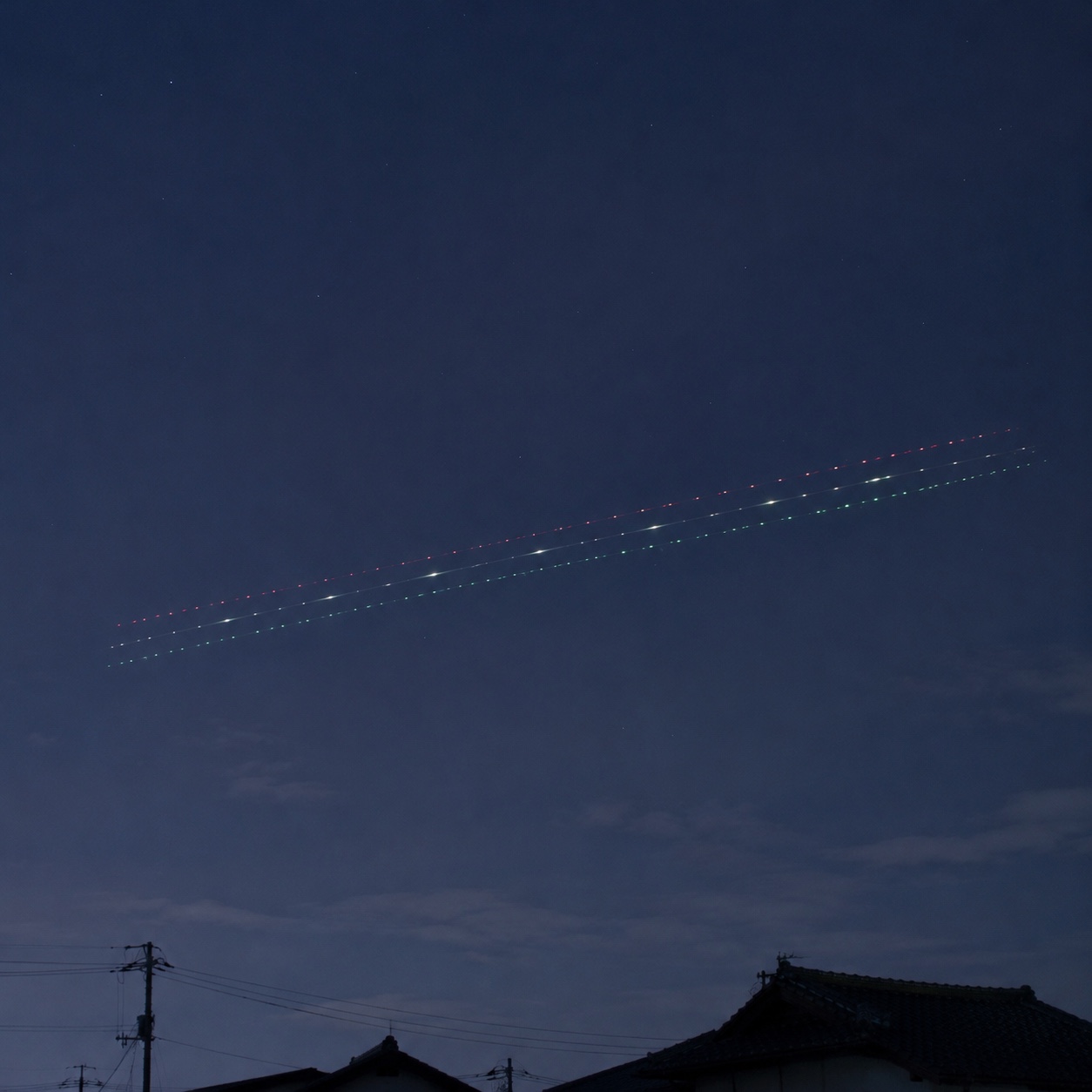
Red Light in the Sky: What It Usually Is
Mars, aircraft beacons, tower warning lights, sky lanterns, flares and drones: how to tell what a red light in the night sky is by color, blinking and movement.
Read
Blue Flash in the Sky: What Causes It
A sudden blue or blue-green glow that lights up the sky is often an electrical fault in power equipment. How to tell it from lightning, a fireball or a twinkling star.
Read