
Key points
- Utsuro-bune ("hollow boat") is a strange tale recorded as the arrival, in 1803 (Kyowa 3), of a round vessel and a foreign-looking woman on the shore of Hitachi Province (now the coast of Ibaraki Prefecture, northeast of Tokyo).
- Differing copies survive in several old texts, starting with the essay collection Toen Shosetsu (compiled 1825) by Kyokutei Bakin, along with Ume no Chiri, Oshuku Zakki and others.
- Recent research has compared the sources and proposed a landing site, but no physical evidence confirming that the event happened has been found.
- One theory holds that the written accounts took shape against the culture and knowledge of the time, such as the Konjiki-hime (golden princess) legend connected with silkworm farming.
- It is an example of an unidentified object washed ashore being given different meanings in different eras, and a good subject for showing that "unidentified" does not mean "extraterrestrial."
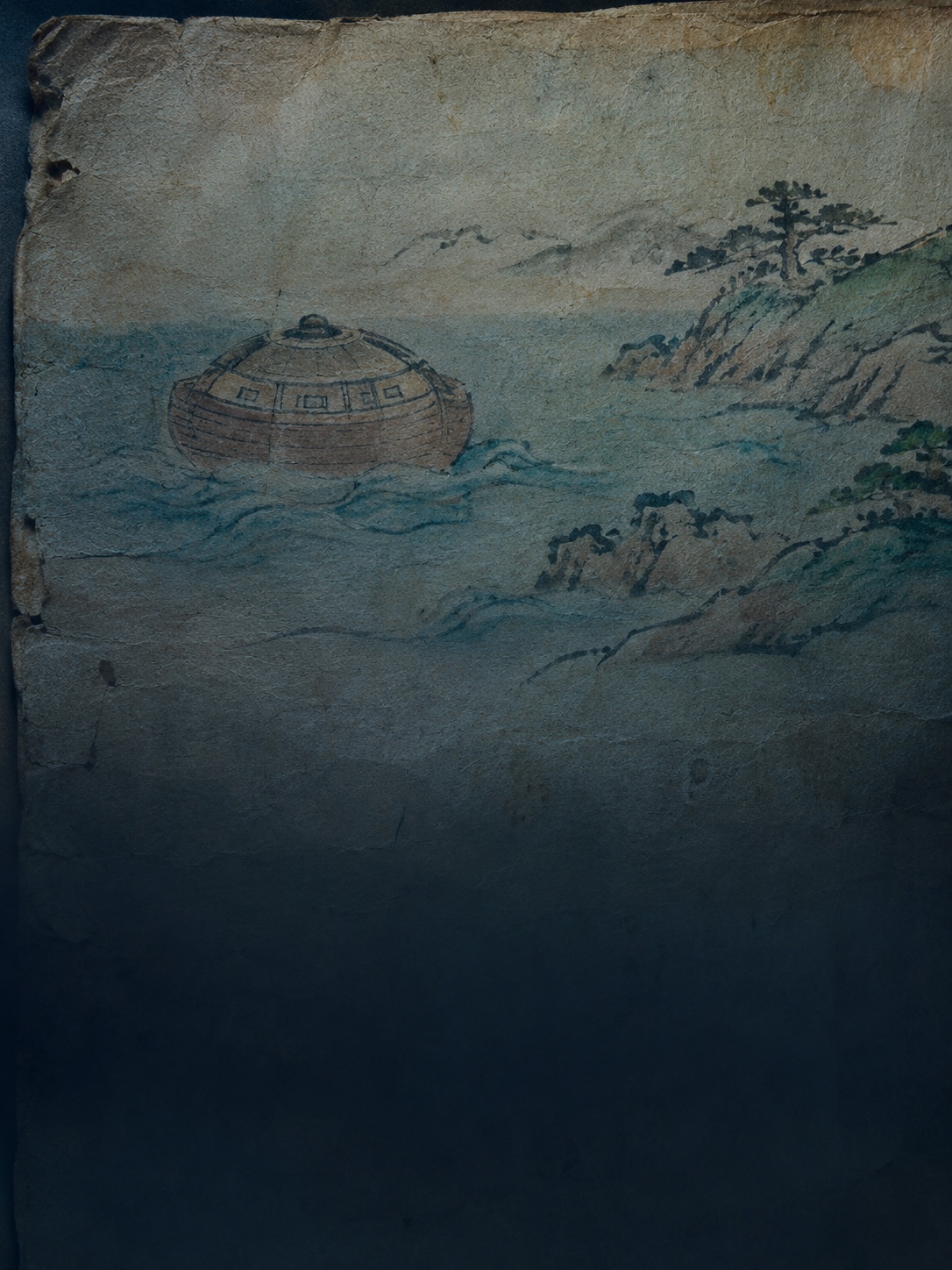
Utsuro-bune ("hollow boat") is one of the castaway tales recorded in texts of Japan's Edo period (1603–1868). The best known is the case said to have washed ashore in Hitachi Province (now the coast of Ibaraki Prefecture) in the third year of the Kyowa era (1803). Because it depicts a round vessel and a foreign-looking woman, today it is often introduced as "the Edo-period UFO."
This page sets out which sources recorded the Utsuro-bune legend and how, then looks, on the facts, at recent research and at what it has in common with the way modern UFOs and UAP (unidentified anomalous phenomena) are talked about. Note that "unidentified" here means something has not been identified. It does not mean extraterrestrial.
The Utsuro-bune legend in brief
According to the old texts, on the 22nd day of the second month of Kyowa 3, something like a boat drifted in from offshore to a beach in Hitachi Province, and people from the shore hauled it onto the beach. The vessel was round like a kogo (a lidded incense box) and a little over 3 ken (about 5.4 meters, or 18 ft) long. The upper part had glass-paned panels sealed with pine resin, and the bottom was described as built of iron plates laid in overlapping steps.
Inside the vessel was a woman who spoke no language anyone understood. Her eyebrows and hair were red, and she reportedly wore a long white hairpiece. She held a box about 2 shaku (about 60 centimeters, or 2 ft) square and would not let go of it, and many unfamiliar characters were written on the inside of the vessel. These are the main elements that appear across several of the copies.
Figures and details differ between sources
The old texts that recorded it
The Utsuro-bune story became widely known largely because of Toen Shosetsu, an essay collection left by Kyokutei (Takizawa) Bakin (1767–1848), known as a writer of popular novels, and others. It collects strange tales and scholarly inquiries shared at the Toen-kai, a gathering of Edo literati and curio enthusiasts, and was compiled in Bunsei 8 (1825). The Utsuro-bune story is included, with an illustration, under the title "The Foreign Woman of the Hollow Boat."
But Toen Shosetsu is not the only text to record Utsuro-bune. Several copies survive, including Yashiro Hirokata's Hirokata Zuihitsu, Nagahashi Matajiro's Ume no Chiri (1844) and Komai Norimura's Oshuku Zakki. Researchers' surveys have reportedly identified a dozen or so related sources so far.
Scroll the table sideways →
| Source | Person associated | Approximate date |
|---|---|---|
| Toen Shosetsu | Kyokutei (Takizawa) Bakin and the Toen-kai | Bunsei 8 (1825) |
| Hirokata Zuihitsu | Yashiro Hirokata | Late Edo period |
| Ume no Chiri | Nagahashi Matajiro | 1844 |
| Oshuku Zakki | Komai Norimura | Late Edo period |
These copies differ in place names, details of the vessel, descriptions of the woman and so on. Whether they record the same event or reflect changes as the story was retold is debated, and examination by comparing the primary sources continues today.
Recent research and the proposed landing site
Kazuo Tanaka, professor emeritus at Gifu University, and others have collected and compared the sources on the Utsuro-bune legend. Tanaka published a book summarizing his research in 2009 and an English-language study in 2019, and he is known as a leading researcher on Utsuro-bune.
In 2014 it was reported that a newly found document, the Ban family papers, gives the landing site, whose name had until then been unclear, as "Hitachihara Sharihama." This is said to correspond to Sharihama in Hasaki, in present-day Kamisu City, Ibaraki Prefecture, and it has drawn attention as a clue linking the legend to a specific place.
However, such identifications are interpretations based on what the sources say. No physical evidence has been found to confirm that the vessel or the woman existed. Many researchers treat the Utsuro-bune story not as a question of whether the event really happened, but as a "history of interpretation": how the sources were written and how they were passed down.
How to read the sources
Parallels with modern UFO stories
The Utsuro-bune legend overlaps in several ways with how modern UFOs and UAP are talked about: an unidentified object, unfamiliar writing, a being who cannot be communicated with, and a "box" that is never let go. These can be read as showing how people try to find a story in something they cannot explain.
Researchers have suggested that the characters in the vessel were decorative designs or foreign symbols known at the time, and that local culture, such as the Konjiki-hime (golden princess) legend about the origin of silkworm farming, lay behind the tale. The folklorist Kunio Yanagita called the story a baseless fabrication, while also noting that there may have been some basis that made people believe it. In other words, without invoking anything extraterrestrial, there have been repeated attempts to explain how the story arose from the knowledge and culture of the time.
The 1803 castaway tale is a record from more than 100 years before the word "UFO" spread. That it has been reread across the ages as "the Edo-period UFO" itself shows how unidentified things have been given different meanings in different eras.
How to think about "unidentified"
The Utsuro-bune legend is an example of an unidentified object washed ashore being told as a strange tale in one era and as a UFO story in another. Even the same source has been given different meanings depending on the reader and the era. The same pattern applies to lights in the sky and unidentified phenomena today.
- 1First, check "when, where, who and what" was recorded.
- 2Look at the differences between copies or accounts, and identify the parts that changed.
- 3Do not assume anything extraterrestrial; consider other explanations, such as the culture, knowledge and natural phenomena of the time.
- 4Check whether there is physical evidence, and suspend judgment on what cannot be confirmed rather than asserting it.
"Unidentified" describes a state in which what something is remains unknown. Whether to link it to "extraterrestrial" is a separate question. The Utsuro-bune legend is a subject that shows that difference through history.
FAQ
What is the Utsuro-bune legend?+
It is a strange tale, recorded in several Edo-period texts, that in 1803 (Kyowa 3) a round vessel washed ashore on a beach in Hitachi Province (now the coast of Ibaraki Prefecture, Japan) carrying a foreign-looking woman who spoke no language anyone understood. Today it is often introduced as "the Edo-period UFO."
Which old texts record it?+
The best-known is Toen Shosetsu (compiled 1825), an essay collection by Kyokutei Bakin and others. Several other copies survive, including Hirokata Zuihitsu, Ume no Chiri (1844) and Oshuku Zakki, and researchers' surveys have reportedly identified a dozen or so related sources.
Did Utsuro-bune really happen?+
No physical evidence confirming that the vessel or the woman existed has been found. Many researchers treat it less as a question of truth than as a history of interpretation: how the sources were written and passed down. There is also discussion identifying the landing site as Sharihama in Hasaki, Kamisu City, Ibaraki Prefecture, but that too is an interpretation based on the sources.
Why is it called "the Edo-period UFO"?+
Because elements such as the round shape, the unfamiliar writing and a being who cannot be communicated with overlap with how modern UFOs and UAP are talked about. But this is a later interpretation, and research explaining how the story arose from the culture and knowledge of the time has also accumulated.
UFO Kanteishi Exam, Grade 3
Free, no account needed. 20 questions on observing, recording and cross-checking. Pass and get a certificate with a verifiable number.
To become a Licensed UFO Kanteishi, take Grade 2 (Official Guide + exam).
Related reading
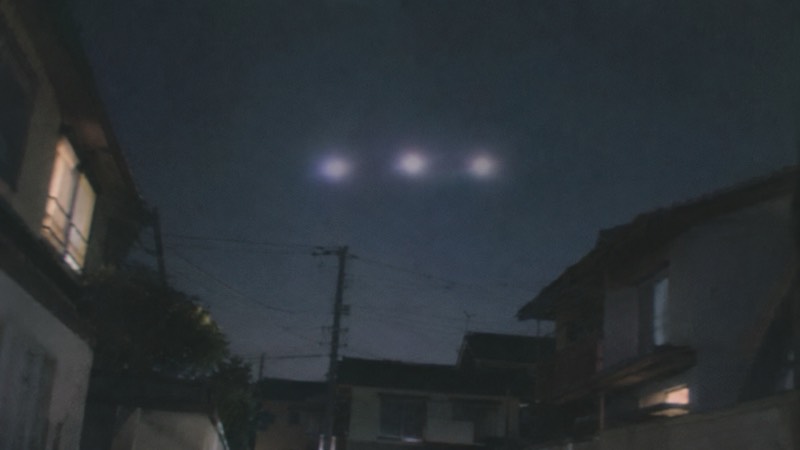
Japan's Three Great UFO Incidents
The Kofu, Kera and Nikoro incidents, with both sides laid out calmly, including skeptical assessments. A guide to reading primary sources.
ReadUFO vs. UAP: the difference
ReadHow to evaluate UFO information: information literacy
Read
Cosmo Isle Hakui and Japan's UFO Town
A space science museum in Hakui, Ishikawa. How to view real space hardware and UFO materials as separate things.
Read